While visiting the home show in downtown Hartford earlier in January my friend and I stopped to talk to a local green energy company about solar panels. Instantly, the salesman pulled up my friend’s house on google maps, pointed out her West-facing roof (a good thing) and in no time we were debating the pros and cons of solar energy.
One of his biggest arguments for solar was that “energy prices in Connecticut doubled”, effective Jan. 1. Turns out that two well-known utility companies are doubling their supply rates, pushing up the cost by approximately 40% more than last winter.
I called a friend who lives in New Hartford that installed solar panels a few years ago, to find out how it was working out.
“We did it because we wanted to do our bit for the environment and not be so dependent on the electric companies,” said Delia Thomas. “Solar panels have saved us a tremendous amount of money.”
To alleviate the large upfront expense of buying the panels, solar companies now offer leasing options or loans, much like financing a new car. And the newest renewable energy contracts allow residents to sell their unused solar power back to their utility company, at a fixed rate.
Offshore Wind Farms is another innovation expanding around New England, with new developments like Revolution Wind. Anticipated to be fully operational in 2025, this promises to make enough clean energy for more than 350,000 homes in Connecticut and Rhode Island.
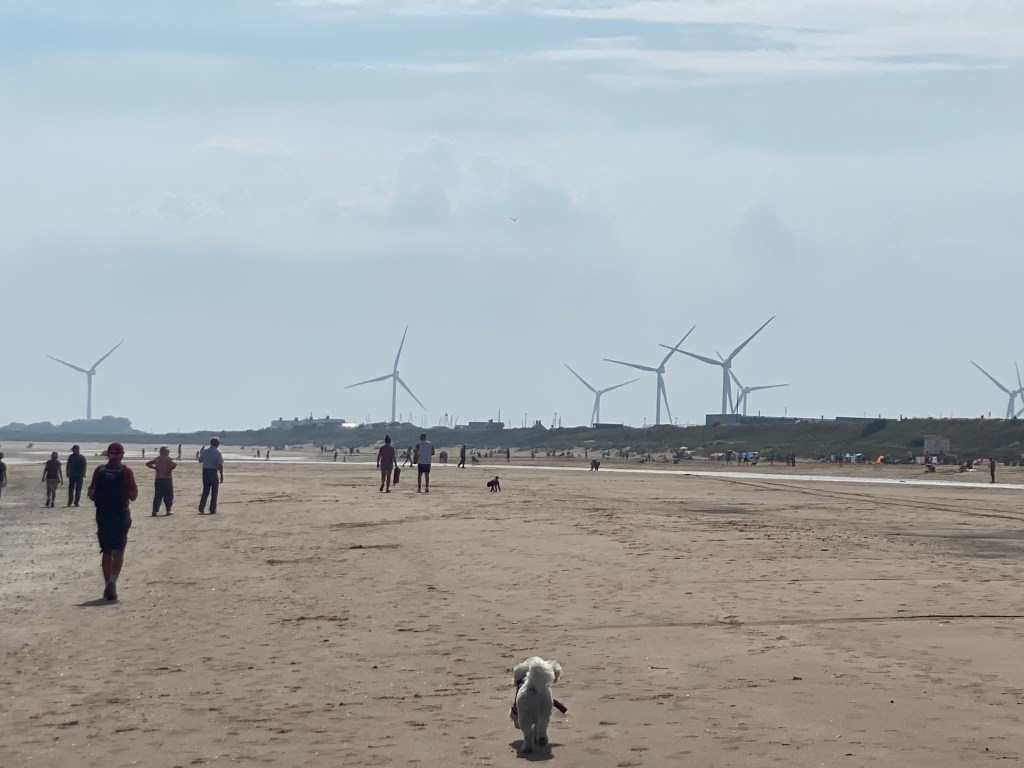
I’m familiar with wind farms from my trips to the UK, where imposing turbines loom over the green landscapes. It’s worth it to stand and watch those blades turning slowing, extracting energy so gracefully as a show of human ingenuity. Hornsea One, sits offshore on the East Ridings coastline powering 1 million homes in the area. A bit further down the coastline at Fraisthorpe beach where the above photo was taken, lies a land-based wind farm, which generates power for 23,000 homes in the area.
Back in Connecticut, there are aggressive goals for the reduction of greenhouse gas emissions and plans to grow the renewable energy market. According to an NBC review of Connecticut’s energy sources in June 2022, the Millstone Nuclear Power Plant in Waterford generates a whopping 38% of the state’s power.
Despite all the promise of renewables, solar generates only 2% and wind only 1% of Connecticut’s energy, so we’re poised for growth. While green energy may not be top of mind for many residents, there are many incentives that make renewables worth a second look.
 On A Mission
Responses to blog