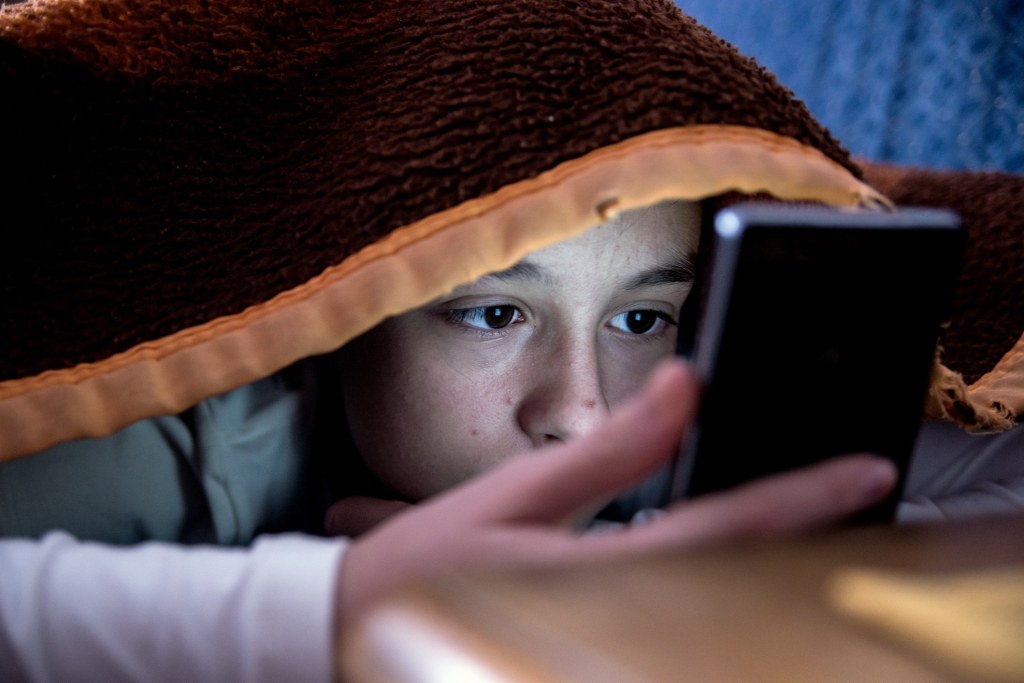
Creating focus through technology sounds contradictory. Tristan Harris, former technology design ethicist walked away from a plumb role at Google because he couldn’t influence the core of its business model, which was to keep people locked into their devices.
After all, social media is designed to keep people is leap frogging from one topic or video to another, losing hours each day in apps, news feeds and the intentionally designed never ending scroll feature.
Relationship with Technology
I’ve abstained from large parts of technology, turning off Siri and just this week turned Screen Time back on to see what my daily data consumption looks like. I did this because at times I felt under the thumb of a faceless technological superpower designed to extract behavioral information at the kind of micro-level I don’t want to share because it makes me feel controlled.
Deciding what to give up wasn’t that difficult because I’m not a heavy online user. I already gave up Spelling Bee so that left me with only one thing: stop looking at my phone in the late evening, which I sometimes do to relax after 10:30 p.m.
Okay—let’s give this experimentation a whirl:
It’s Tuesday, June 6, 2023 and class with Professor Bloomer finished around 6 pm. I’ve been tooling around on Blackboard, the portal Quinnipiac uses for all its classes, looking at the Data Project by two transatlantic friends who creatively documented a specific topic each week, dropped it onto a postcard and mailed it to each other as a way of closing the distance.
Initial hypothesis: I am going to walk over to my phone after 10 p.m. I may even pick it up if I’m not present and look at the news or What’s App to see what is happening with my family in England. I’ll curse and put the phone down when I realize what I’m doing.
How it played out: I spent more time this week on evening email than I usually do, but once I shut that down, I didn’t pick up the phone after 10:30 a.m. and after a few days I noticed I was waking up earlier, even before my alarm clock went off at 6:20 a.m. Over the weekend, I woke up by 7:30 a.m. both days, earlier than usual.
So, cutting out the late evening phone time may be having a positive benefit on my morning routine. I need to track this over a longer period, and keep up the new habit up for another week to see if it continues.
Where Is It All Going?
Shoshana Zuboff in her 2019 book, The Age of Surveillance Capitalism, coins the term a “human futures markets”, where technology companies harvest information from consumers often without their knowing for the purposes of understanding them better in order to generate more revenue. Whatever happened the concept of Permission Marketing?
In the Netflix docudrama, The Social Dilemma (2020), Zuboff says that great predictions are founded on large data. If this data is collected unbeknownst to the average consumer and copied into information technology systems to inform how individuals are targeted, isn’t this a sophisticated form of identity theft? If you can’t detect it easily, it doesn’t mean it doesn’t exist — it’s a magic trick of smoke and mirrors.
I like the idea of shifting the center of gravity away from pure technology and towards sociology with humanity’s best interests in mind. This is perhaps what drove the former google technologist Tristan Harris to cofound the Center for Humane Technology.
An earlier visionary named in Stolen Focus: Why You Can’t Pay Attention–and How to Think Deeply Again (Hari, 2023) is Aza Raskin who said, “We make technology because it takes the parts of us that are most human, and it extends them. It’s about making us extra-human.”
Our society has a long way to go to realize this vision, especially among impressionable youth who are dominated by their social media feeds.
 On A Mission
Responses to blog