I have heard that most people overestimate what they can achieve in a year and underestimate what they can accomplish in five years. Every day is an opportunity to create a clean slate for attacking a number of tasks that ladder up to achieving larger goals that fit within an organization’s purpose.
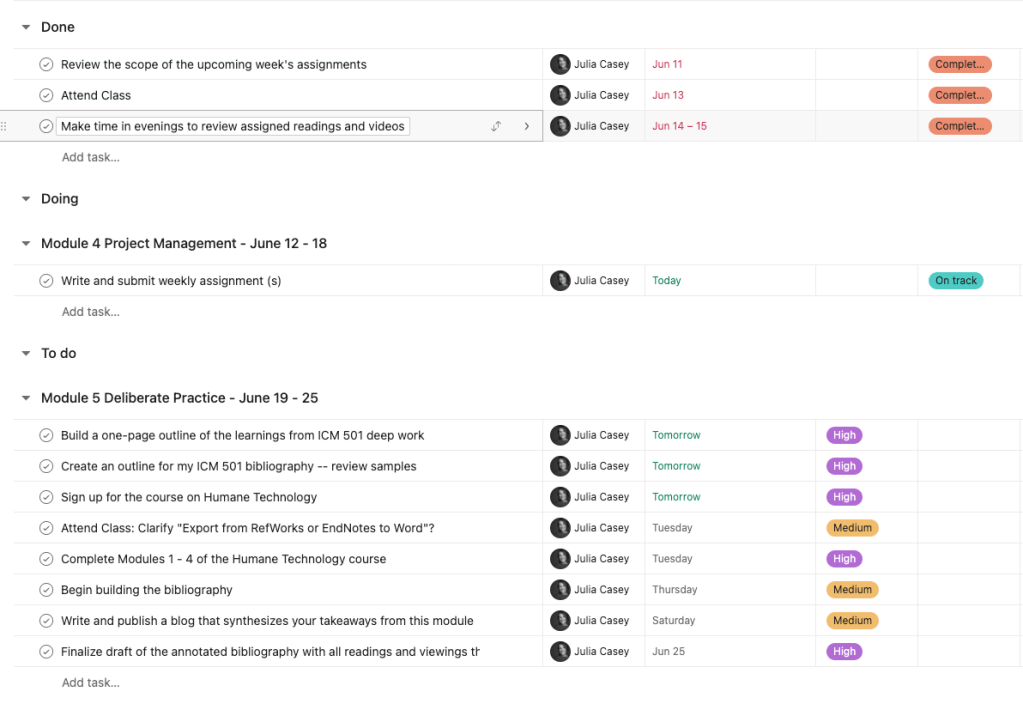
After briefly looking at a few project management options including Trello and Monday.com I decided to try out Asana, which is a flexible form of web-based project management that batches assignments into two-to-four-week deliverables, with the flexibility to iterate and reflect. Work is organized into three large buckets: To Do, Doing and Done.
To kick the wheels of the Asana software, I went through Modules 4 – 7 of the ICM 501 class and mapped out key tasks, assigned dates and tested out how to move tasks around and organize the items from week four that I have already done into the “Done” pile. I also tried creating a new status option called “Completed” because finishing something is part of the reward for putting a project plan together in the first place.
Everyone has their own preference for viewing projects and for me something like the following view is a helpful reference point so I can tackle the most urgent first. I also like that Asana lets you share project plans with other people so the deadlines and overall prioritization can be agreed up front, and then renegotiated to navigate new developments, changing priorities and unforeseen roadblocks.
I also see that Asana works with Gmail, Microsoft Outlook and even SalesForce. It looks like you can add tasks straight from the software to your calendar which is an awesome feature.
Some of the most organized people I know spend time every day on their to-do’s, constantly reorganizing what they plan to do. Project Management Software like Asana creates a clean visual view of a project not only for the team working on an assignment, but for others in an organization who want to understand the work going on within a department and who is doing what kind of assignments. It has been many years since I read David Allen’s book, Getting Things Done: The Art of Stress-Free Productivity (2001) where he stresses knowing the next thing to do.
Being organized and sharing what you are working on others with others builds understanding if everyone is committed to using it as a way to keep the ball moving forward.
Allen, D. T. (2001). Getting Things Done: The Art of Stress-Free Productivity.
 On A Mission
Responses to blog