
While watching @mrbeast, one of YouTube’s top creators introduce his latest Wilderness Challenge, it is easy to get locked in. There are all the elements of a good story with a brief intro., rising tension, peak, fall and then wrap. The essence of the competition is people sleep in the great outdoors for a princely sum of $10,000 a day, which is parachuted daily to those who survive.
This twenty-six minute video is significantly longer than the average twelve-minute video, garnering over 40 million views, 3 thousand likes and 180,000 comments in just the first day.
@mrbeast is just one of many who makes up the “creator economy” YouTube Chief Executive Officer Neal Mohan referred to in his Feb. 6, 2024 blog. Here he makes four predictions for the future of YouTube including AI’s ability to expand creative boundaries, not inhibit them.
“YouTube has paid over $70 billion to creators, artists, and media companies in three years.”
Toby Hendy is another popular creator with 1.22M subscribers. Toby liked science documentaries in school so started to make her own. At the age of 15, she uploaded her first science video to @tibees. Two hundred and eighty-nine videos and 1.22M subscribers later, her content authority led to an opportunity for her to gather the perspective of politicians and business leaders on today’s school exams in their country. Her video scored 4.6K likes and more than 200 comments about exam ptsd:
People with stressful jobs react to world’s most stressful exams
YouTube has become the most widely used social media channel according to Pew Research’s Jan. 2024 fact sheet and second-largest search engine, following Google. People are now spending an average of 48.7 minutes daily watching YouTube videos in 2024, which is trending upwards according to Sproutsocial. And most people using YouTube are on a mobile device.
In a world that offers a plethora of news, entertainment and education options, it is clear that video content can capture and hold the viewers’ attention like no other channel, with engaging stories, documentaries and video shorts.
In an election year, using YouTube as an outlet for reliable news is an opportunity, especially with young adults.
About a quarter of U.S. adults get news from YouTube
Per Pew Research survey, Jan. 6 – 20, 2020
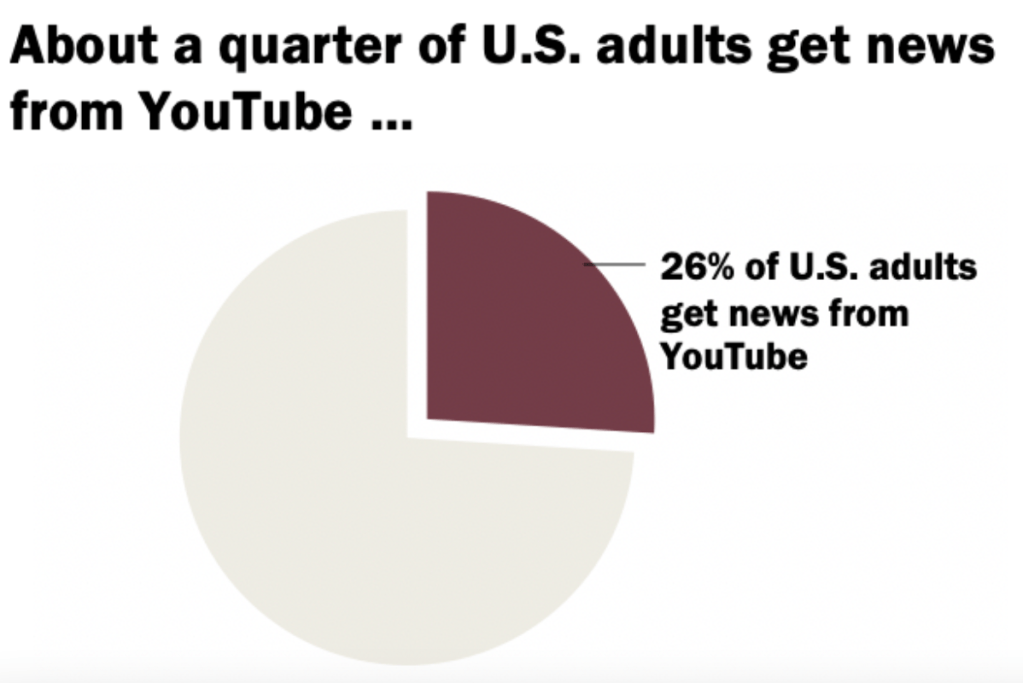
Most of these people say it is one way they get their news, but not the only way. Many reputable news outlets use video stories to augment their written content.
My guess is a year from now this number will be up to at least 30 percent.
While there are still times when the written word is a better choice than video, such as a long research paper or an in-depth news story heavy on statistics, there is nothing like video for demonstrating or explaining versus telling and selling.
 On A Mission
Responses to blog