Wading through a sea of Artificial Intelligence (AI) content is how I spent most of my time this week. With an approved proposal to explore AI’s Potential to Help Nonprofits Inspire Generosity and a skeleton bibliography, I dove into the subject head-first.
It wasn’t long before I found myself in a multiple internet tab-opened, swampy head space of new information. Knowing that my first long-form LinkedIn article is focused on helping nonprofits develop an AI Policy, there was quite a bit to review. This included reading the perspective of technologists and marketers.
Bibliography
Here are some of the key points that emerged this week:
- In supply-constrained organizations, including nonprofits, generative AI can provide people a productivity boost through prompt-based text and image content.
- The quality of what comes out is influenced by the way prompts are written.
- Used well, AI can augment creativity as AI generated information can’t be taken at face value. People should always review information to ensure its accuracy, adjust the tone as needed and ensure content is in line with an organization’s values.
- I share below the results of my experimentation with the AI tool Copilot as well as the image tool, DALL-E3.
- Information ownership depends on who designs the AI tool and any contractual agreements that organizations have in place with an AI developer.
- Many nonprofits may use an off-the-shelf AI product so they should understand how AI products deal with algorithmic bias, potential misuse and unintended consequences.
I wanted to test the popularity of certain phrases over time so used the Google Trends tool to gauge the use of these terms in U.S. based Google searches: AI, artificial intelligence, AI policy and Responsible AI. While not specific to any one sector, it shows a significant rise in “AI” Google searches in the past five years.

Copilot: an everyday AI companion
I decided to experiment with Microsoft’s Copilot AI tool because I have a level of trust with Microsoft products. As I went through my bibliography around the use of AI and ethics, I read something that made me wonder, who owns AI generated content and is it regulated in the United States? After some online searches, I couldn’t find U.S. regulations, so I decided to ask my Copilot and here is what it told me:
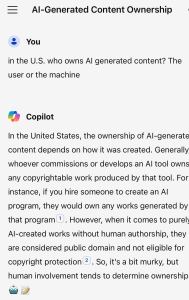
If the machine owns images and they are combined with text from a content creator in say a web article or social media post, then who owns that combined output? As a person taking a content creation class, I am curious to know.
AI-Generated Images
Experimenting with the DALL-E-3, to see what kind of imagery I could “create” using AI was a worthwhile use of my time this week.
First Prompt: Draw me an illustration of a group of teenage boys representing multiple ethnicities playing basketball in a large court enclosed with fencing.

Second Prompt: Can you crop the image to show five teenage basketball players of multiple ethnicities, with one scoring a basket?

I then tried a third prompt requesting, “only five basketball players” and I got the below, so this particular image didn’t come out as I had hoped.

Project Plan Updates
Based on feedback from Prof. PB Hastings, I also updated the project plan to include blogging about my process, instead of blogging about my primary topic. So now there is an additional card showing Weekly Diary build.
I’m ending this week, knee-deep in AI content while I continue to experiment with the Copilot AI tool.
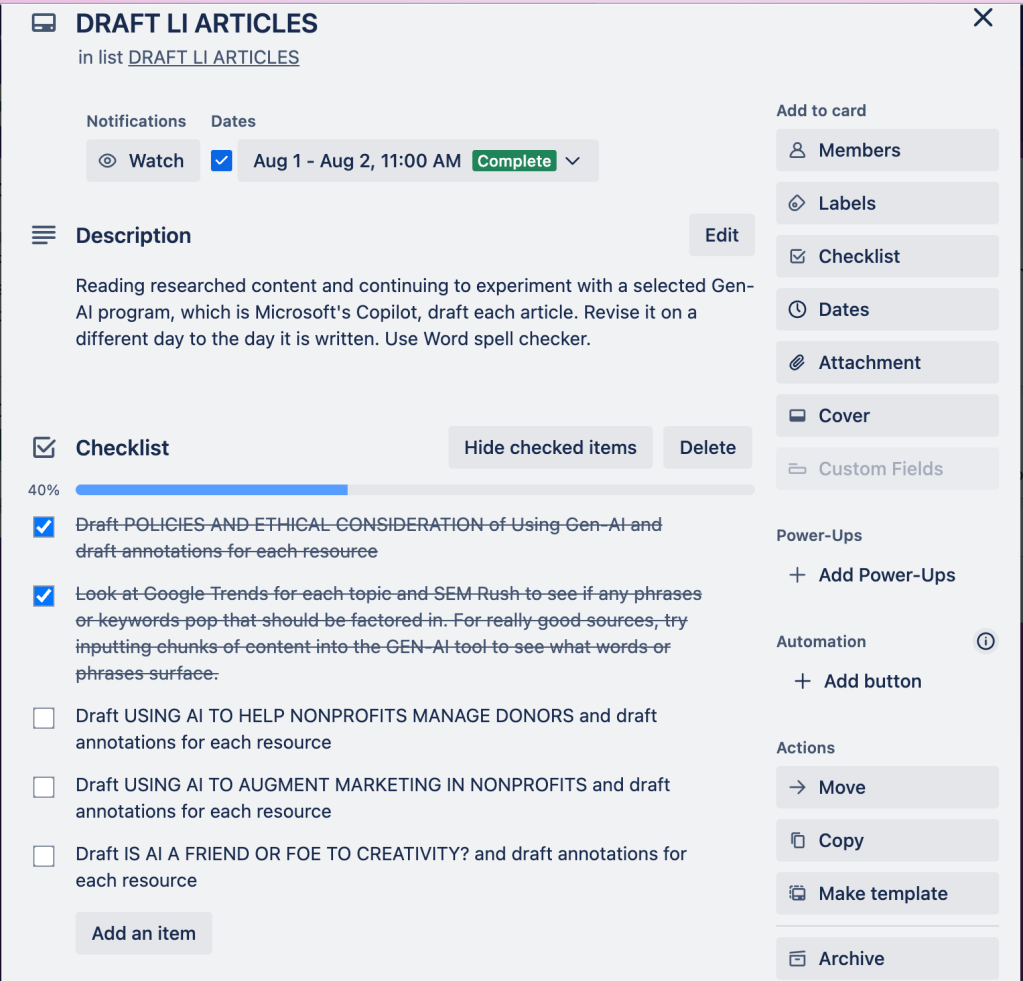
A draft of my first AI article will be submitted along with a Production Journal, which is essentially a timesheet of hours spent this week on different project tasks.
Not surprisingly, there isn’t much information on nonprofits use of AI, so my assumption is a full AI integration is more common in large organizations. There is real untapped potential if there is an appetite and resources to consider the gains and consequences in using AI to accelerate productivity and creativity.
 On A Mission
Responses to blog