
While still wading through a wide range of articles and information about AI, by now I’m more familiar with the topic and somewhat more comfortable with its promises and perils. Mustafa Suleyman who cofounded an AI company spoke at the 2024 World Economic Forum describing the present moment as the “most transformational moment, not just in technology, but in culture and politics.” Some of the perils I have read about include issues of national security so government oversight is growing and will continue.
This week I read about the benefits of establishing an AI Council or Committee to oversee an organization’s use of this technology and how it should be introduced to employees. I also skimmed guidelines developed by the Alan Turing Institute that looks at different aspects of AI ethics and safety. This includes identifying the risks associated with the introduction of AI and defining measures to mitigate them or develop contingency plans. This guide is designed for ensuring AI ethics and safety is built into “the design and implementation of algorithmic systems in the public sector.”
Beyond AI ethics and evaluating potential risks the picture gets rosier. There are several ways nonprofits can use AI for the purposes of segmenting its donor base and creating tailored messages.
Here are a few AI tools for nonprofits that help to analyze donors:
- Raiser’s Edge: This tool uses analytics to help nonprofits understand donor behaviors and preferences, making it easier to design effective fundraising strategies.
- Funraise’s Appeal AI This suite includes analysis and forecasting tools, automated alerts, and pre-built fundraising reports to help nonprofits understand donation trends and optimize their fundraising efforts.
- Donor box: This platform uses AI to screen prospective donors, segment audiences, and create predictive models about donor behavior, helping nonprofits identify new donor sources and engagement strategies.
These tools can significantly enhance a nonprofit’s ability to understand and engage with their donor base, leading to more successful fundraising campaigns.
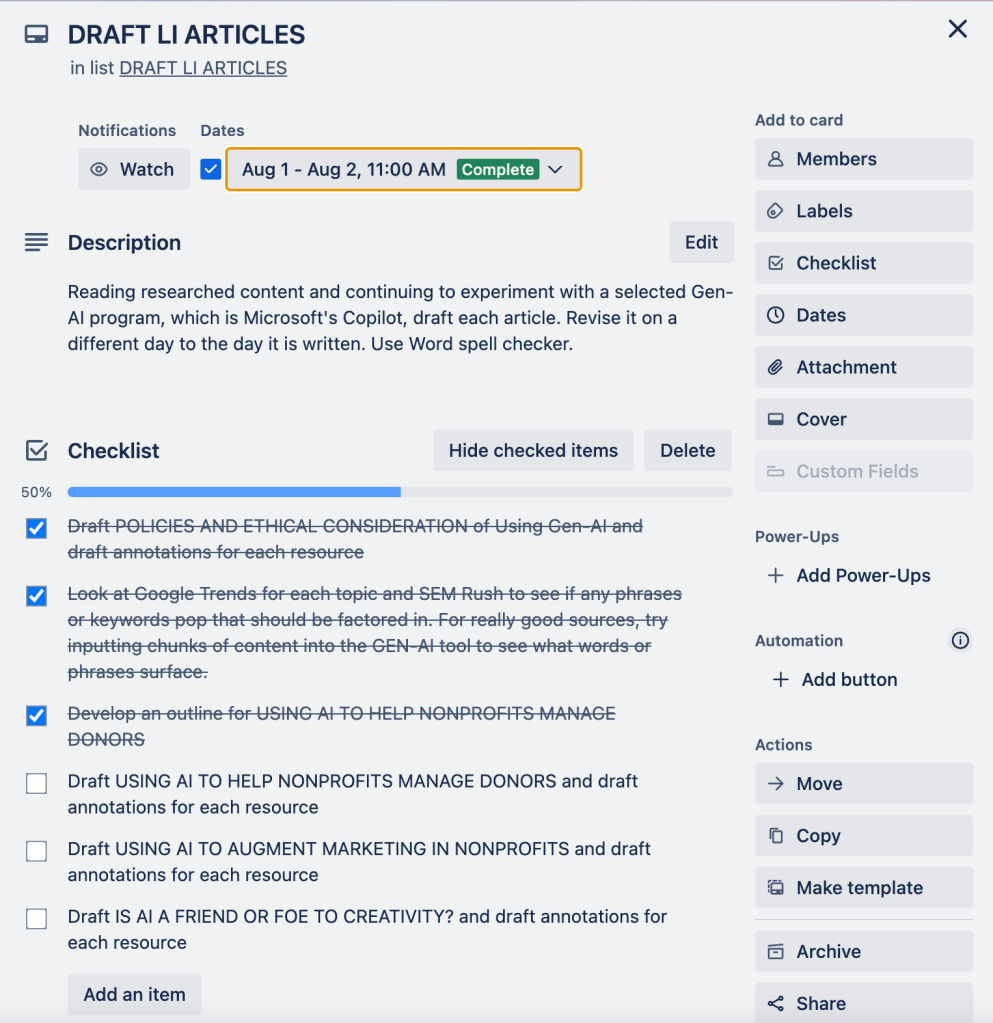
As we moved through week four of the course, I made a few adjustments to the project plan, which are reflected in the following image created using the Trello project management site:
Those nonprofits that choose to adopt AI in a way that is consistent with its Mission, Values and information privacy controls stand to gain more than the risks it assumes. The key is taking a 360-degree approach, while gathering feedback and training its people to gently pull off the band aid versus ripping it all off at once.
 On A Mission
Responses to blog