
People give to nonprofits for a host of reasons, but one of the primary ones is a deep belief in an organization’s mission. Being donor-centric shifts the focus from fundraising-to- relationship building, and AI can help nonprofits do this with greater precision.
In the book The Generosity Crisis, the case for radical connection to solve humanity’s greatest challenges, Nathan Chappell discusses the value of AI models in their ability to study and understand different giving levers in prospective donors.
“Studying prospect mentality through the lens of emerging tech is a true lesson in patternmaking. Sophisticated AI can uncover subtle signals no human can, indicating when someone is about to make their first gift.”
At the time of the above book’s publication in 2023, the “State of Artificial Intelligence in the Nonprofit Sector” study indicated that only 25 percent of nonprofits report AI in use within their organizations, compared to the almost universal adoption in private companies.
According to DonorSearchAI, a tool that uses analytics to help nonprofits understand donor behaviors, some of the most promising industries for success with AI are healthcare and higher education because they have lots of data in their university databases and in their Electronic Medical Record Systems (EMRS).
Giving USA
Donors who are engaged, thanked and communicated with are going to stay. That’s obvious. The interesting thing I’ve learned is that the amount of money someone gives doesn’t always directly correlate with their wealth. Yes, there are mega gifts from the ultra-wealthy, which contributed nearly 5 percent of individual giving in 2022, according one analysis of Giving USA’s annual report. And yes, the stock market cycles and disasters like the pandemic play a role in overall giving trends.
Below is a breakdown of U.S. philanthropy from Giving USA, which shows individuals are by and large contributing the lion’s share of generosity, but corporations are giving more than in prior years because they know a value-based approach to business is a winning formula.
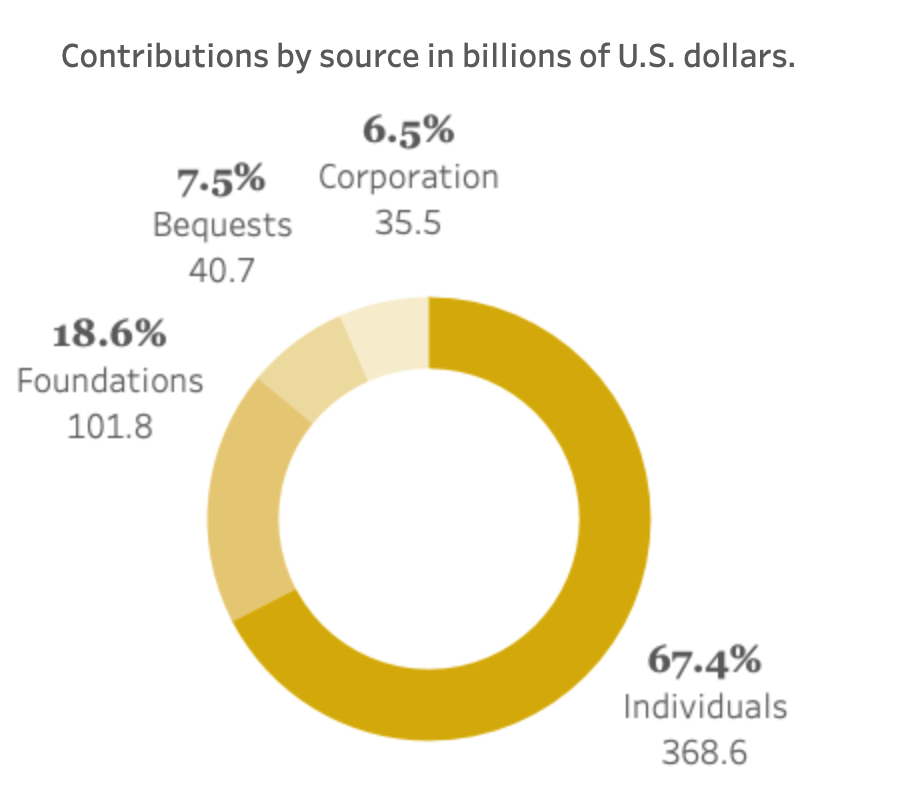
According to this same source, religion, human services and education have consistently been the top three benefactors of giving.
Donor Experience Data
For AI to work well it needs lots of high-quality information about donors, their personal characteristics, historic giving patterns and specifics about their interactions with the nonprofit.
According to Copilot, here are the kind of data AI needs to find actionable insights that can help nonprofits market more precisely and segment prospects to find those who are most likely to give for the first time, have similar characteristics to major donors etc:
- Donor Demographics: information such as age, gender, location, occupation, and education level.
- Donation History: records of past donations.
- Engagement Data: interaction history with the nonprofit, including event attendance and volunteer activities.
- Email and Communication Data: frequency of email exchanges, responses to campaigns and other channels including social media.
- Wealth Indicators: property ownership, stock holdings and other assets.
During the pandemic when restaurants, hotels and cafes shut down, a group of college students concerned about the resulting food waste sprang into action. The farmlink project was designed to connect farmers produce with foods banks and transport crops to communities who needed it before it was destroyed.
Nathan Chappell used DonorSearch AI to help write case studies and provide the fledgling organization with data to help provide insights. The following video shows how they banded together to stand up a new organization that houses and transports food into communities that need it the most.
There is also a plethora of chatbots and virtual assistants that promise to respond to donors and website visitors 24/7. Personally, except for the most routine inquiry, I find chatbots to be detractors, instead of a friendly voice on the end of a line with the information you need.
There are dozens of AI applications promising to help nonprofits analyze their donors to optimize fundraising efforts. As discussed in last week’s blog, ensuring AI is used in a way that builds trust with a nonprofit donors and other partners is one of the primary considerations.
 On A Mission
Responses to blog