-
An Adaptable Approach to Productivity
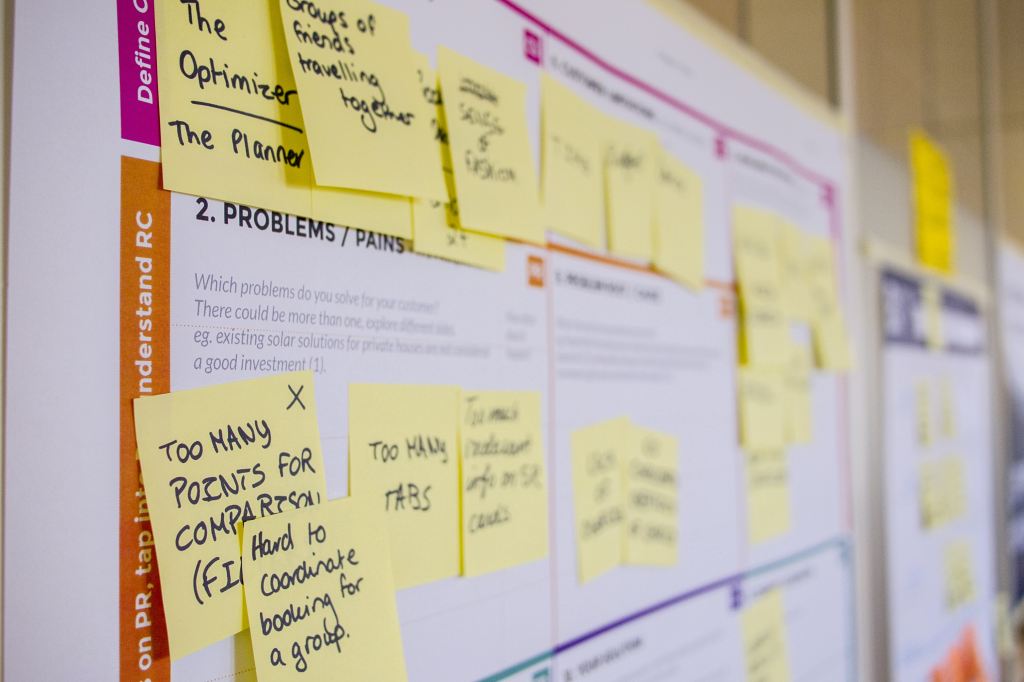
I have heard that most people overestimate what they can achieve in a year and underestimate what they can accomplish in five years. Every day is an opportunity to create a clean slate for attacking a number of tasks that ladder up to achieving larger goals that fit within an organization’s purpose.
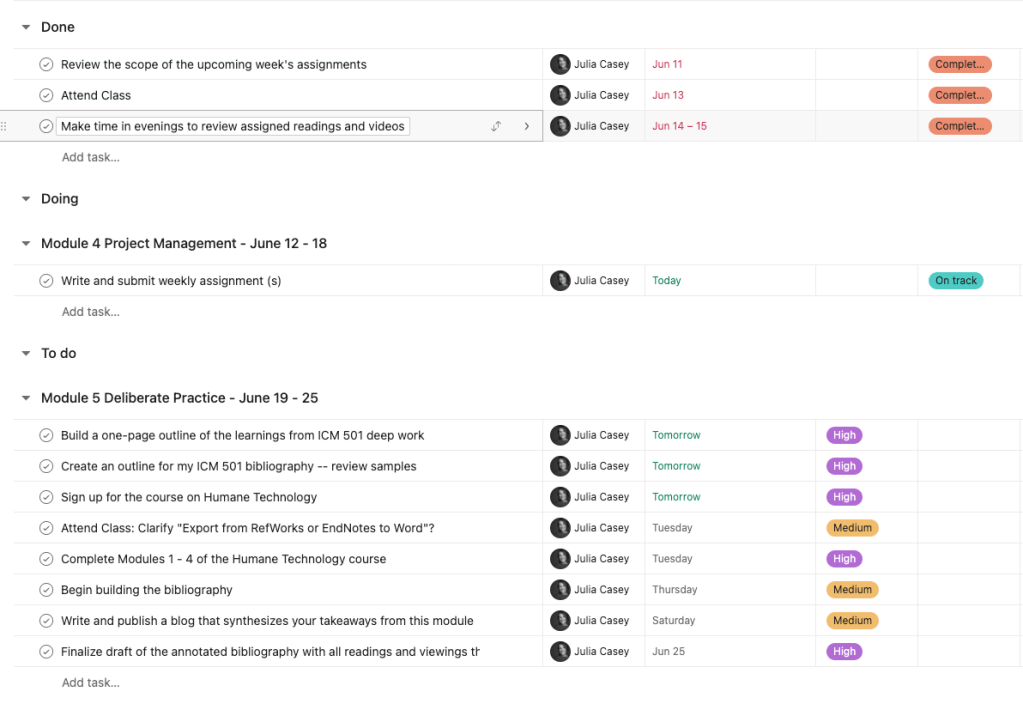
After briefly looking at a few project management options including Trello and Monday.com I decided to try out Asana, which is a flexible form of web-based project management that batches assignments into two-to-four-week deliverables, with the flexibility to iterate and reflect. Work is organized into three large buckets: To Do, Doing and Done.
To kick the wheels of the Asana software, I went through Modules 4 – 7 of the ICM 501 class and mapped out key tasks, assigned dates and tested out how to move tasks around and organize the items from week four that I have already done into the “Done” pile. I also tried creating a new status option called “Completed” because finishing something is part of the reward for putting a project plan together in the first place.
Everyone has their own preference for viewing projects and for me something like the following view is a helpful reference point so I can tackle the most urgent first. I also like that Asana lets you share project plans with other people so the deadlines and overall prioritization can be agreed up front, and then renegotiated to navigate new developments, changing priorities and unforeseen roadblocks.
I also see that Asana works with Gmail, Microsoft Outlook and even SalesForce. It looks like you can add tasks straight from the software to your calendar which is an awesome feature.
Some of the most organized people I know spend time every day on their to-do’s, constantly reorganizing what they plan to do. Project Management Software like Asana creates a clean visual view of a project not only for the team working on an assignment, but for others in an organization who want to understand the work going on within a department and who is doing what kind of assignments. It has been many years since I read David Allen’s book, Getting Things Done: The Art of Stress-Free Productivity (2001) where he stresses knowing the next thing to do.
Being organized and sharing what you are working on others with others builds understanding if everyone is committed to using it as a way to keep the ball moving forward.
Allen, D. T. (2001). Getting Things Done: The Art of Stress-Free Productivity.
-
Cutting Out Late Night Technology

Creating focus through technology sounds contradictory. Tristan Harris, former technology design ethicist walked away from a plumb role at Google because he couldn’t influence the core of its business model, which was to keep people locked into their devices.
After all, social media is designed to keep people is leap frogging from one topic or video to another, losing hours each day in apps, news feeds and the intentionally designed never ending scroll feature.
Relationship with Technology
I’ve abstained from large parts of technology, turning off Siri and just this week turned Screen Time back on to see what my daily data consumption looks like. I did this because at times I felt under the thumb of a faceless technological superpower designed to extract behavioral information at the kind of micro-level I don’t want to share because it makes me feel controlled.
Deciding what to give up wasn’t that difficult because I’m not a heavy online user. I already gave up Spelling Bee so that left me with only one thing: stop looking at my phone in the late evening, which I sometimes do to relax after 10:30 p.m.
Okay—let’s give this experimentation a whirl:
It’s Tuesday, June 6, 2023 and class with Professor Bloomer finished around 6 pm. I’ve been tooling around on Blackboard, the portal Quinnipiac uses for all its classes, looking at the Data Project by two transatlantic friends who creatively documented a specific topic each week, dropped it onto a postcard and mailed it to each other as a way of closing the distance.
Initial hypothesis: I am going to walk over to my phone after 10 p.m. I may even pick it up if I’m not present and look at the news or What’s App to see what is happening with my family in England. I’ll curse and put the phone down when I realize what I’m doing.
How it played out: I spent more time this week on evening email than I usually do, but once I shut that down, I didn’t pick up the phone after 10:30 a.m. and after a few days I noticed I was waking up earlier, even before my alarm clock went off at 6:20 a.m. Over the weekend, I woke up by 7:30 a.m. both days, earlier than usual.
So, cutting out the late evening phone time may be having a positive benefit on my morning routine. I need to track this over a longer period, and keep up the new habit up for another week to see if it continues.
Where Is It All Going?
Shoshana Zuboff in her 2019 book, The Age of Surveillance Capitalism, coins the term a “human futures markets”, where technology companies harvest information from consumers often without their knowing for the purposes of understanding them better in order to generate more revenue. Whatever happened the concept of Permission Marketing?
In the Netflix docudrama, The Social Dilemma (2020), Zuboff says that great predictions are founded on large data. If this data is collected unbeknownst to the average consumer and copied into information technology systems to inform how individuals are targeted, isn’t this a sophisticated form of identity theft? If you can’t detect it easily, it doesn’t mean it doesn’t exist — it’s a magic trick of smoke and mirrors.
I like the idea of shifting the center of gravity away from pure technology and towards sociology with humanity’s best interests in mind. This is perhaps what drove the former google technologist Tristan Harris to cofound the Center for Humane Technology.
An earlier visionary named in Stolen Focus: Why You Can’t Pay Attention–and How to Think Deeply Again (Hari, 2023) is Aza Raskin who said, “We make technology because it takes the parts of us that are most human, and it extends them. It’s about making us extra-human.”
Our society has a long way to go to realize this vision, especially among impressionable youth who are dominated by their social media feeds.
-
East Meets West

The focus of Stolen Focus: Why You Can’t Pay Attention–and How to Think Deeply Again (Hari, 2023) is the double-edge sword of technology’s benefits and how Western societies have tipped the balance to the point of constant overwhelm and distraction. Stolen Focus highlights the way Silicon Valley is geared to steal mindshare, to the point of unhealthy manipulation in the name of profit.
Capabilities like websites infinite scrolling and Snapchat streaks became the advancements that consumer engagement technologists chased while banning their own offspring from the very programs they designed.
In Jay Shetty’s book, Think Like A Monk (2020) he shares the wisdom gained from his multi-year sabbatical living with monks in contrast to Western lifestyles where technology feeds our brains with a steady dopamine hit as we bounce from scrolling news feeds, YouTube videos and seemingly endless streams of social media.
Shetty shares a story about taking a shower in India, which involved a muddy trek in flip flops to find a creaky outdoor stall where he couldn’t distinguish between the cold water falling from the overhead shower and the rain that had begun. The benefit of this primitive and uncomfortable situation in his estimation was that it “strengthened his resolve”.
“True growth requires understanding the mind. It is the filter, judge, and director of all our experiences, but, as evidenced by the conflict I felt on my shower adventure, we are not always of one mind.” (2020)
Once we quell any external distractions and discomforts, we can turn our attention to our internal thought processes. Oprah Winfrey refers to these as the “quiet whispers” that point you in the right direction. Activities may include:
- Keeping a diary as a way to empty the mind on paper with either things you are grateful for or things that are bothering you.
- “Single-tasking” like reading, painting, walking or meditation – anything that is immersive where we lose track of time.
If I have an hour to take care of my health, I prefer to go to the gym than sit quietly and meditate. I took a class many years’ ago where the instructor sounded a Tibetan singing bowl and we sat there in silence for an hour, which felt like an eternity.
In the Sanskrit language of Hindu philosophy, the term for a monk is brahmacharya, which means ‘the right use of energy’ (2020). While four hours of daily meditation is unlikely for most, we are beginning to wake up to the intellectual, emotional and social costs of hours lost in ‘technology space’.
-
Reclaiming Your Attention

It has been said that the best gift you can give someone is your attention. I believe this to be true. As someone who likes to contemplate, I’ve begun to realize just how much I’ve missed the mark by falling in and out of my own thoughts and the hubbub of the world around.
From what I’ve read, human brains are like lava lamps, producing squishy jellyfish-like thoughts every second or two. What do we have to go with the chicken for dinner? What gift should I buy my mom for her birthday? What color should I paint the living room, and so on.
In Johann Hari’s Guardian article[1] he shares a story from the introduction to his latest book, Stolen Focus. Why You Can’t Pay Attention – and How to Think Deeply Again.[2] The author espouses that human attention is diminishing because of the ever-increasing demands of technology. So, when the author takes his godson to Graceland on a trip under the stipulation that he doesn’t bring his phone and then finds him on Snapchat, there is a poignant moment where the Godson acknowledges there is a problem, then goes right back to texting.
This sounds more like the definition of insanity.
In my home I bought a small wooden box engraved with quippy sayings like, “Talking is the new texting,” “High-Speed connecting, no Wifi required.” Everyone was supposed to put their phone in there during dinner, but mostly I’m just happy if the phone is in the pocket during dinner.
Technology can be likened to other forms of addiction, with all of the same seductive powers and equally damaging side-affects that can destroy a precious commodity: our minds.
In Hari’s book, Professor Earl Miller from MIT referred to the effect of task-switching as “a perfect storm of cognitive degradation.” We know attention spans are shortening across the board thanks to the 24-hour news cycle and there is a plethora of digital channels to splinter our attention. PhD Amishi Jha wrote a book called Peak Mind[3] where she shares the benefits of meditation on strengthening our attention. She prescribes twelve minutes of meditation a day, running extensive research on its long-term benefits for strengthening focus and improving receptivity. Using the metaphors of a flashlight for finding focus and birds for improving receptivity, the author describes the changes that take place in the brain after several weeks of regular meditative practice.
I love the section in the article where Hari slows down and gets a better sense for how he is feeling, describing a “gurgling inside,” which he realizes is a sense of calm.
Finding places and spaces to decompress is critical and I very much relate to Hari’s description of his time at the Cape. So many writers and artists find inspiration in nature. For me, I have found that everything opens up when I’m in a natural habitat, including my ability to think more expansively. Providing I can put down my phone for long enough.
[1] Hari, Johann, Your attention didn’t collapse. It was stolen. The Guardian.
[2] Hari, Johann, Stolen Focus. Why You Can’t Pay Attention – and How to Think Deeply Again, 2023 Crown Trade Paperback.
[3] Jha, Amishi P. PhD, Peak Mind, Find Your Focus, Own Your Attention, Invest 12 Minutes A Day, 2021
-
The Unjust Cycle of Debt & Desperation
I am writing a long-form paper about the work options available to U.S. prisoners including rates of pay, in addition to evaluating some newer practices that are working well in certain states, as a means of helping people to be better prepared for reentry into their home community.
In his book On Writing Well, William Zinsser said “there is nothing more interesting than the truth”, so I wanted to look at the way people are paid for the work they do while incarcerated, and expose the inhumanity of paying people pennies, and what it means for their overall welfare, and the well-being of the communities they rejoin upon release.
In coming up with an interesting ‘teaser’ for the promotion, I decided to relay a compelling fact or truth that would get the attention of advocates and policy makers.
Channels: Twitter, LinkedIn, Facebook
Twitter message immediately below is written from the perspective of an Advocate for incarcerated people appealing to Legislators who are in influential government positions:
On Oct. 1, 1957 the CT minimum wage was $1 per hour. Today incarcerated people in CT prisons earn 30 cents – $1 an hour, shackling them in a cycle of debt and desperation upon release. Let’s change this.
(190 characters)
#CriminalJusticeReform #Equity #Connecticut
Some time ago Elon Musk doubled his character length from 140 to 280 characters, and from what I read on PRnewsonline the ideal length of a tweet is 70-100 characters. While I didn’t distill what I wanted down this far, I reduced it to 150 characters in the second example below by removing the first sentence:
Today incarcerated people in CT prisons earn 30 cents – $1 an hour, shackling them in a cycle of debt and desperation upon release. Let’s change this.
(150 characters)
#CriminalJusticeReform #Equity #Connecticut
I chose a single U.S. dollar as the visual. Simple and to the point.
Also came across Twitter Notes, a way for writers to attach longer blog-style writing to a short ‘index’ on Twitter. Perhaps this is still in test-mode with select writers before a full nationwide rollout. I did not find it as a public feature in my Twitter account.
LinkedIn message is again written from the perspective of an Advocate for incarcerated people appealing to business decision makers who may have unfilled openings that formerly incarcerated people can fill. It is a message about giving people a second chance.
There are thousands of skilled workers under DOC community supervision or returning home to CT after incarceration who are ready and willing to fill vacancies you hold. Are you willing to give someone a second chance?
#Justice #Reentry #SecondChance #Connecticut
I chose to talk to people in first-person versus third, to encourage the reader to think about what decisions are within their control.
In real life, I would create versions that focus on specific industries like manufacturing, food services or transportation. In these situations, I would mention a specific certification(s) and use a visual that speaks to that industry, targeting specific industries in posting it to LinkedIn.
Facebook is a channel geared for social networking among friends and family, where people share pictures of birthdays, holidays and everyday life. In this channel I took a different tact, focusing instead of people who may know someone who is or was justice-involved and may be willing to submit testimony to the Connecticut General Assembly.
Today incarcerated people in CT prisons earn 30 cents – $1 an hour, shackling them and their families into a cycle of debt and desperation upon release. If you know someone who is justice involved, help create the change for someone to be successful upon reentry by contacting your legislator in the town where you live or work, or by submitting written testimony to the CT General Assembly.
#JusticeReform #Reentry #Connecticut
-
The Joy of Live Theater
The red velvet curtain swung open to make a fishtail. The spotlight fell on four sharply-suited doo-woppers who clicked their fingers to the swing of their hips, as they belted out ‘Big Girls Don’t Cry’.
For the next two hours, we were swept into a dramatized slice of American life. A behind-the curtain peek into the life and times of Frankie Valli and the Four Seasons, set in New Jersey in the 1950’s-60’s. I had gone with my parents who were in New York for a long weekend to celebrate their 60th wedding anniversary. I glanced over to the check their expressions and quickly swung my head back to the stage, so I didn’t miss another second.
Frankie Valli and the Four Seasons closed in 2021, but the experience is one we will never forget.
Unlike other forms of escapism, there is no hangover with theater. Just a prolonged happy buzz that flies around your head in infinity circles for months and years to come. According to Statista, live performance theater sales in the United States rebounded almost 21% in 2022, climbing to 8.4 bn U.S. dollars and anticipated to increase in 2023 to reach 8.7 billion.
Hats off to all the producers, writers and performers who all make modest means to do the creative work they love. If you have ever visited the Starlight Diner in New York City, you know what I mean. The wait staff stand on tables as they charm you with Broadway hits in the hopes that a talent scout will “discover” them.
The Netflix Musical, Tick Tick …. Boom! looked at the life of musical composer Jonathan Larson, who wrote Rent and tragically died before the musical’s first showing. His own experience living on the bread line as an aspiring composer led him to write songs about marginalized people living with HIV/AIDS in the 1980’s.
Rent was a musical I saw in the 1990’s at the Bushnell Theater in Hartford. The back story and stomping musical feet are still with me.
Whether you are moved to tears at the loss of Eva Peron in Evita or feel like boogying in the aisles to Mamma Mia! every night at the theater has its own story that will enrich you for eternity.
#joy #theater
-
Talkin’ about Evolution
As I was driving to work last week listening to Spotify, the playlist turned to Tracy Chapman, an artist I’m familiar with from my college days. I was transported to Sheffield, an industrial city in northern England, where I drove my little red Fiesta that my dad helped me acquire for three thousand pounds.
Don’t you know, talkin’ about a revolution
It sounds like a whisper
While Chapman is an incredible American success story, when you look at the research around income and education across different demographic groups, there’s more out there on the disparities than progress.
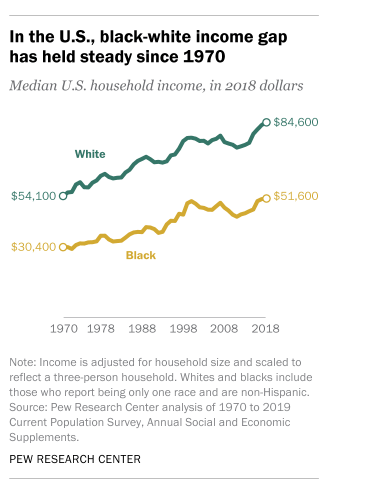
According to the Pew Research Center, median black household income was 61% of white income in 2018, up slightly from 56% in 1970. In absolute dollars white households have seen a larger increase over this time period (up $30,500) as compared to black households (up $20,200) between 1970 and 2018, so we have a long way to go before the wage gap closes:
While reading an article Why Atlanta Is the Blackest Show Ever, it describes the trapdoors that black people can fall into in the course of a regular day. Like walking down the street, having coffee in Starbucks or minding your own business in Central Park and “next thing a white woman calls 911 and says she feels threatened”.
In my workplace at Community Partners in Action (CPA), we have been talking about the book Me and White Supremacy by Layla F. Saad. It’s one of many books on the topic including How to be an antiracist, by Ibram X Kendi. Layla’s words are direct. I appreciate her straight talk as she educates white people about the black stereotypes that white people hold and the advantages that come from living inside a white skin.
Most of the participants at CPA are black men so I paid close attention to the chapter about the white supremacist view of Blacks. When you look at the criminal justice system and the disproportionate number of black men who are incarcerated, you know why rage exists.
In her Instagram challenge, #MeAndWhiteSupremacy, her soothing voice takes the edge off her directness. This post in particular caught my eye:
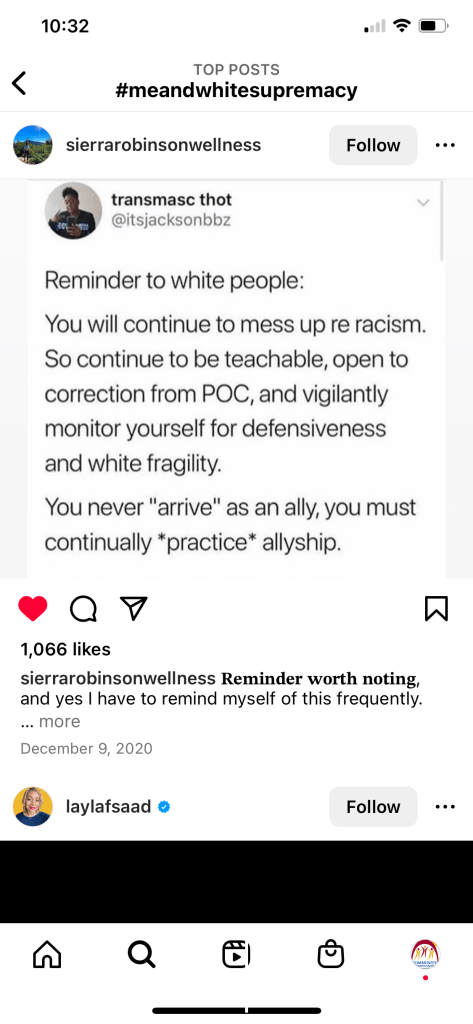
My awareness is raised (thank you Layla), and while to err is to be human, I’ll try to mess up less. So let the tables continue to turn, and pick up speed until “the whisper” is a loud voice inside everyone to move beyond talking.
-
Why the Tide Is Turning Toward Green Energy
While visiting the home show in downtown Hartford earlier in January my friend and I stopped to talk to a local green energy company about solar panels. Instantly, the salesman pulled up my friend’s house on google maps, pointed out her West-facing roof (a good thing) and in no time we were debating the pros and cons of solar energy.
One of his biggest arguments for solar was that “energy prices in Connecticut doubled”, effective Jan. 1. Turns out that two well-known utility companies are doubling their supply rates, pushing up the cost by approximately 40% more than last winter.
I called a friend who lives in New Hartford that installed solar panels a few years ago, to find out how it was working out.
“We did it because we wanted to do our bit for the environment and not be so dependent on the electric companies,” said Delia Thomas. “Solar panels have saved us a tremendous amount of money.”
To alleviate the large upfront expense of buying the panels, solar companies now offer leasing options or loans, much like financing a new car. And the newest renewable energy contracts allow residents to sell their unused solar power back to their utility company, at a fixed rate.
Offshore Wind Farms is another innovation expanding around New England, with new developments like Revolution Wind. Anticipated to be fully operational in 2025, this promises to make enough clean energy for more than 350,000 homes in Connecticut and Rhode Island.
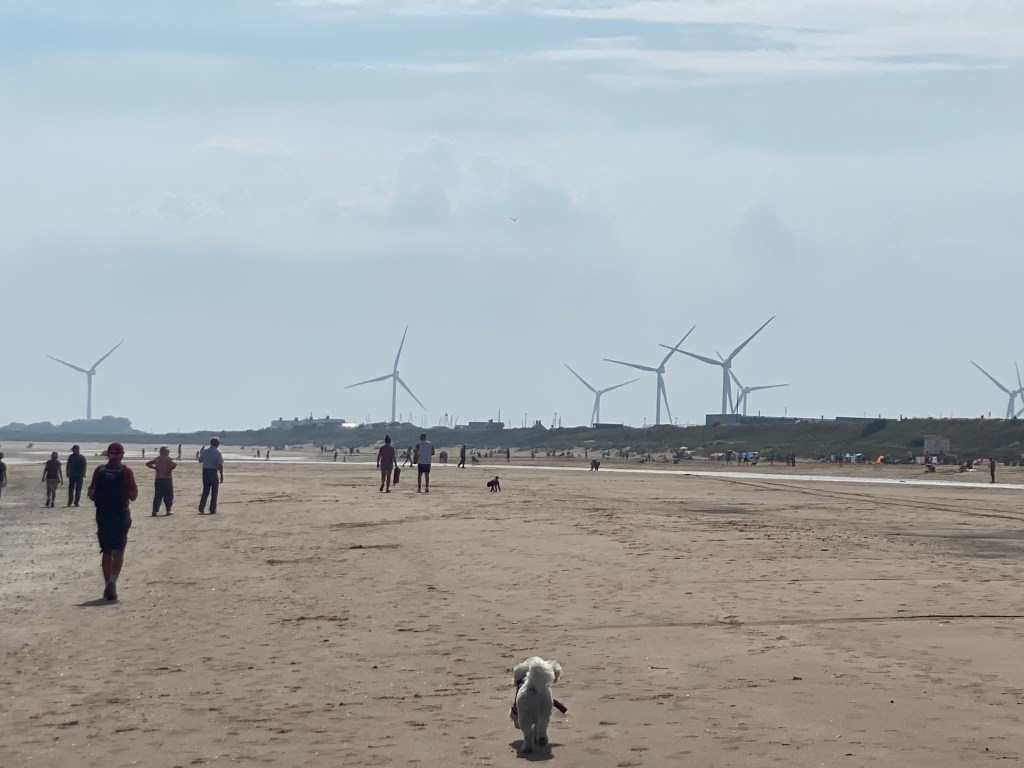
I’m familiar with wind farms from my trips to the UK, where imposing turbines loom over the green landscapes. It’s worth it to stand and watch those blades turning slowing, extracting energy so gracefully as a show of human ingenuity. Hornsea One, sits offshore on the East Ridings coastline powering 1 million homes in the area. A bit further down the coastline at Fraisthorpe beach where the above photo was taken, lies a land-based wind farm, which generates power for 23,000 homes in the area.
Back in Connecticut, there are aggressive goals for the reduction of greenhouse gas emissions and plans to grow the renewable energy market. According to an NBC review of Connecticut’s energy sources in June 2022, the Millstone Nuclear Power Plant in Waterford generates a whopping 38% of the state’s power.
Despite all the promise of renewables, solar generates only 2% and wind only 1% of Connecticut’s energy, so we’re poised for growth. While green energy may not be top of mind for many residents, there are many incentives that make renewables worth a second look.



Leave a Reply