-
AI’s Potential for Nonprofits (Part 3)

This week, as I dove more deeply into the topic of AI use for managing nonprofit donors, I began to realize the reason why it holds so much promise: it requires a TON of high-quality information to work effectively.
This probably explains why the adoption rate is so much lower in nonprofits (around 25%) compared to other for-profit entities that have almost universal adoption of AI, in one form or another. Everything from donor demographics, historic giving, event and volunteer engagement to wealth indicators, and communication engagement information.
One of the main sources of information this week was the Generosity Crisis by Nathan Chappell, Brian Crimmins and Michael Ashley. It reinforced the benefits of using AI to understand donor characteristics and segment them by their potential to engage positively with a nonprofit.
The main takeaway from the Generosity Crisis is that money follows the depth of a personal connection, not the other way around.
– by Nathan Chappell, Brian Crimmins, Michael AshleyI also experimented with Copilot to dig around different topics, like understanding the different data points needed by AI machines. I ran into some interesting visual renditions when trying a version of AI Design software using Bing search (won’t try that again).
Selecting a strong AI-powered machine learning application is a big undertaking, with so many tools to choose from that need to be carefully vetted.
Why this matters comes down to building trust with those who have influence on an organization’s success, by protecting what is theirs. Especially the information and dollars provided to nonprofits by donors in good faith.
Beyond AI use for donor management, I am looking forward to trying out AI for more creative experimentation when I take a closer look at AI’s generative copy drafting for some of the most popular forms of nonprofit communication outreach.
-
How Nonprofits Can Use AI to Manage Donors

People give to nonprofits for a host of reasons, but one of the primary ones is a deep belief in an organization’s mission. Being donor-centric shifts the focus from fundraising-to- relationship building, and AI can help nonprofits do this with greater precision.
In the book The Generosity Crisis, the case for radical connection to solve humanity’s greatest challenges, Nathan Chappell discusses the value of AI models in their ability to study and understand different giving levers in prospective donors.
“Studying prospect mentality through the lens of emerging tech is a true lesson in patternmaking. Sophisticated AI can uncover subtle signals no human can, indicating when someone is about to make their first gift.”
At the time of the above book’s publication in 2023, the “State of Artificial Intelligence in the Nonprofit Sector” study indicated that only 25 percent of nonprofits report AI in use within their organizations, compared to the almost universal adoption in private companies.
According to DonorSearchAI, a tool that uses analytics to help nonprofits understand donor behaviors, some of the most promising industries for success with AI are healthcare and higher education because they have lots of data in their university databases and in their Electronic Medical Record Systems (EMRS).
Giving USA
Donors who are engaged, thanked and communicated with are going to stay. That’s obvious. The interesting thing I’ve learned is that the amount of money someone gives doesn’t always directly correlate with their wealth. Yes, there are mega gifts from the ultra-wealthy, which contributed nearly 5 percent of individual giving in 2022, according one analysis of Giving USA’s annual report. And yes, the stock market cycles and disasters like the pandemic play a role in overall giving trends.
Below is a breakdown of U.S. philanthropy from Giving USA, which shows individuals are by and large contributing the lion’s share of generosity, but corporations are giving more than in prior years because they know a value-based approach to business is a winning formula.
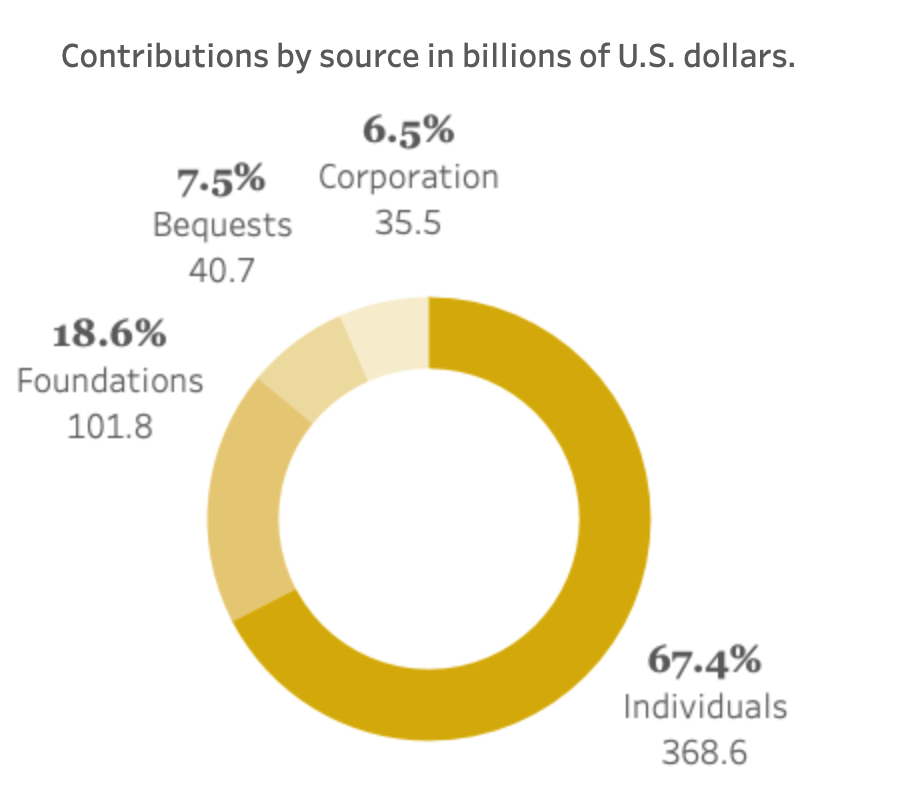
According to this same source, religion, human services and education have consistently been the top three benefactors of giving.
Donor Experience Data
For AI to work well it needs lots of high-quality information about donors, their personal characteristics, historic giving patterns and specifics about their interactions with the nonprofit.
According to Copilot, here are the kind of data AI needs to find actionable insights that can help nonprofits market more precisely and segment prospects to find those who are most likely to give for the first time, have similar characteristics to major donors etc:
- Donor Demographics: information such as age, gender, location, occupation, and education level.
- Donation History: records of past donations.
- Engagement Data: interaction history with the nonprofit, including event attendance and volunteer activities.
- Email and Communication Data: frequency of email exchanges, responses to campaigns and other channels including social media.
- Wealth Indicators: property ownership, stock holdings and other assets.
During the pandemic when restaurants, hotels and cafes shut down, a group of college students concerned about the resulting food waste sprang into action. The farmlink project was designed to connect farmers produce with foods banks and transport crops to communities who needed it before it was destroyed.
Nathan Chappell used DonorSearch AI to help write case studies and provide the fledgling organization with data to help provide insights. The following video shows how they banded together to stand up a new organization that houses and transports food into communities that need it the most.
There is also a plethora of chatbots and virtual assistants that promise to respond to donors and website visitors 24/7. Personally, except for the most routine inquiry, I find chatbots to be detractors, instead of a friendly voice on the end of a line with the information you need.
There are dozens of AI applications promising to help nonprofits analyze their donors to optimize fundraising efforts. As discussed in last week’s blog, ensuring AI is used in a way that builds trust with a nonprofit donors and other partners is one of the primary considerations.
-
AI’s Potential for Nonprofits (Part 2)

While still wading through a wide range of articles and information about AI, by now I’m more familiar with the topic and somewhat more comfortable with its promises and perils. Mustafa Suleyman who cofounded an AI company spoke at the 2024 World Economic Forum describing the present moment as the “most transformational moment, not just in technology, but in culture and politics.” Some of the perils I have read about include issues of national security so government oversight is growing and will continue.
This week I read about the benefits of establishing an AI Council or Committee to oversee an organization’s use of this technology and how it should be introduced to employees. I also skimmed guidelines developed by the Alan Turing Institute that looks at different aspects of AI ethics and safety. This includes identifying the risks associated with the introduction of AI and defining measures to mitigate them or develop contingency plans. This guide is designed for ensuring AI ethics and safety is built into “the design and implementation of algorithmic systems in the public sector.”
Beyond AI ethics and evaluating potential risks the picture gets rosier. There are several ways nonprofits can use AI for the purposes of segmenting its donor base and creating tailored messages.
Here are a few AI tools for nonprofits that help to analyze donors:
- Raiser’s Edge: This tool uses analytics to help nonprofits understand donor behaviors and preferences, making it easier to design effective fundraising strategies.
- Funraise’s Appeal AI This suite includes analysis and forecasting tools, automated alerts, and pre-built fundraising reports to help nonprofits understand donation trends and optimize their fundraising efforts.
- Donor box: This platform uses AI to screen prospective donors, segment audiences, and create predictive models about donor behavior, helping nonprofits identify new donor sources and engagement strategies.
These tools can significantly enhance a nonprofit’s ability to understand and engage with their donor base, leading to more successful fundraising campaigns.
As we moved through week four of the course, I made a few adjustments to the project plan, which are reflected in the following image created using the Trello project management site:
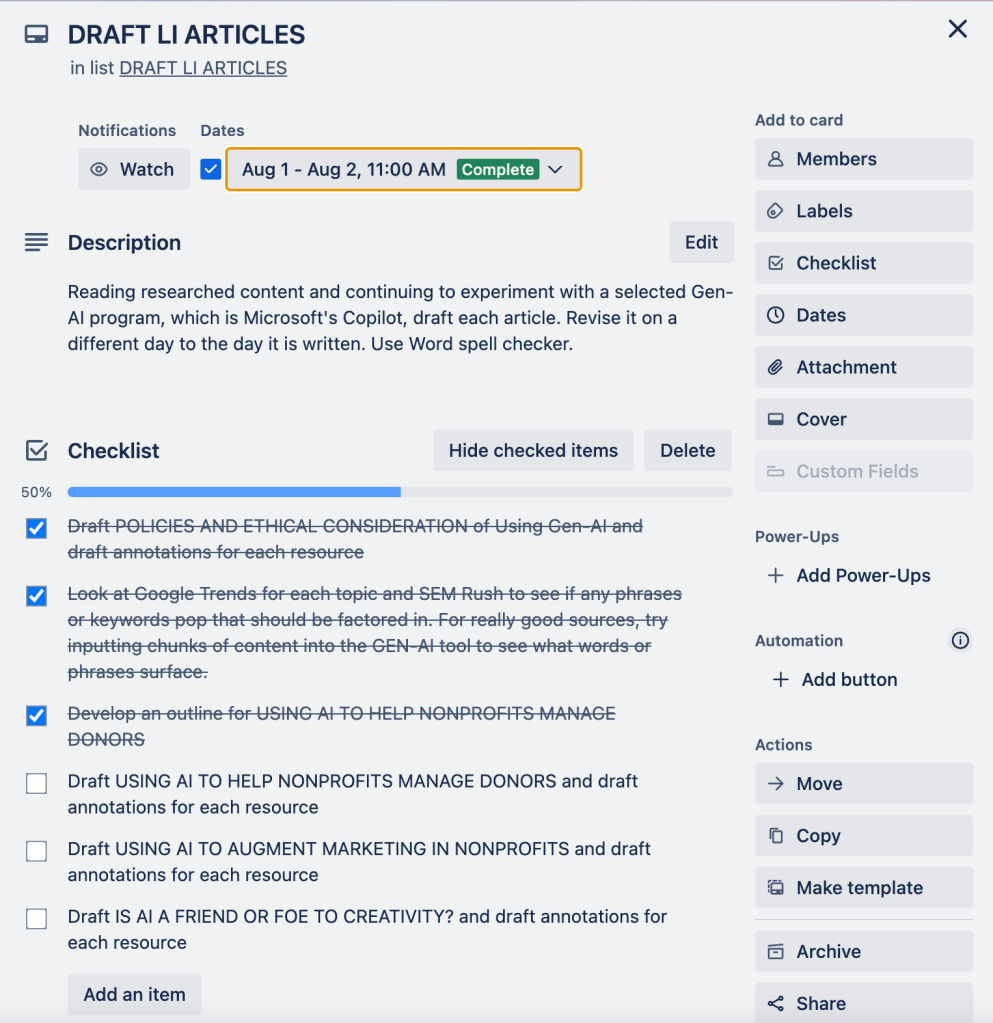
Those nonprofits that choose to adopt AI in a way that is consistent with its Mission, Values and information privacy controls stand to gain more than the risks it assumes. The key is taking a 360-degree approach, while gathering feedback and training its people to gently pull off the band aid versus ripping it all off at once.
-
AI’s Potential for Nonprofits (Part 1)
Wading through a sea of Artificial Intelligence (AI) content is how I spent most of my time this week. With an approved proposal to explore AI’s Potential to Help Nonprofits Inspire Generosity and a skeleton bibliography, I dove into the subject head-first.
It wasn’t long before I found myself in a multiple internet tab-opened, swampy head space of new information. Knowing that my first long-form LinkedIn article is focused on helping nonprofits develop an AI Policy, there was quite a bit to review. This included reading the perspective of technologists and marketers.
Bibliography
Here are some of the key points that emerged this week:
- In supply-constrained organizations, including nonprofits, generative AI can provide people a productivity boost through prompt-based text and image content.
- The quality of what comes out is influenced by the way prompts are written.
- Used well, AI can augment creativity as AI generated information can’t be taken at face value. People should always review information to ensure its accuracy, adjust the tone as needed and ensure content is in line with an organization’s values.
- I share below the results of my experimentation with the AI tool Copilot as well as the image tool, DALL-E3.
- Information ownership depends on who designs the AI tool and any contractual agreements that organizations have in place with an AI developer.
- Many nonprofits may use an off-the-shelf AI product so they should understand how AI products deal with algorithmic bias, potential misuse and unintended consequences.
I wanted to test the popularity of certain phrases over time so used the Google Trends tool to gauge the use of these terms in U.S. based Google searches: AI, artificial intelligence, AI policy and Responsible AI. While not specific to any one sector, it shows a significant rise in “AI” Google searches in the past five years.

Source: Google Trends (U.S.) Copilot: an everyday AI companion
I decided to experiment with Microsoft’s Copilot AI tool because I have a level of trust with Microsoft products. As I went through my bibliography around the use of AI and ethics, I read something that made me wonder, who owns AI generated content and is it regulated in the United States? After some online searches, I couldn’t find U.S. regulations, so I decided to ask my Copilot and here is what it told me:
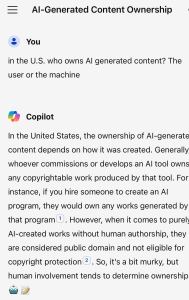
If the machine owns images and they are combined with text from a content creator in say a web article or social media post, then who owns that combined output? As a person taking a content creation class, I am curious to know.
AI-Generated Images
Experimenting with the DALL-E-3, to see what kind of imagery I could “create” using AI was a worthwhile use of my time this week.
First Prompt: Draw me an illustration of a group of teenage boys representing multiple ethnicities playing basketball in a large court enclosed with fencing.

Second Prompt: Can you crop the image to show five teenage basketball players of multiple ethnicities, with one scoring a basket?

I then tried a third prompt requesting, “only five basketball players” and I got the below, so this particular image didn’t come out as I had hoped.

Project Plan Updates
Based on feedback from Prof. PB Hastings, I also updated the project plan to include blogging about my process, instead of blogging about my primary topic. So now there is an additional card showing Weekly Diary build.
I’m ending this week, knee-deep in AI content while I continue to experiment with the Copilot AI tool.
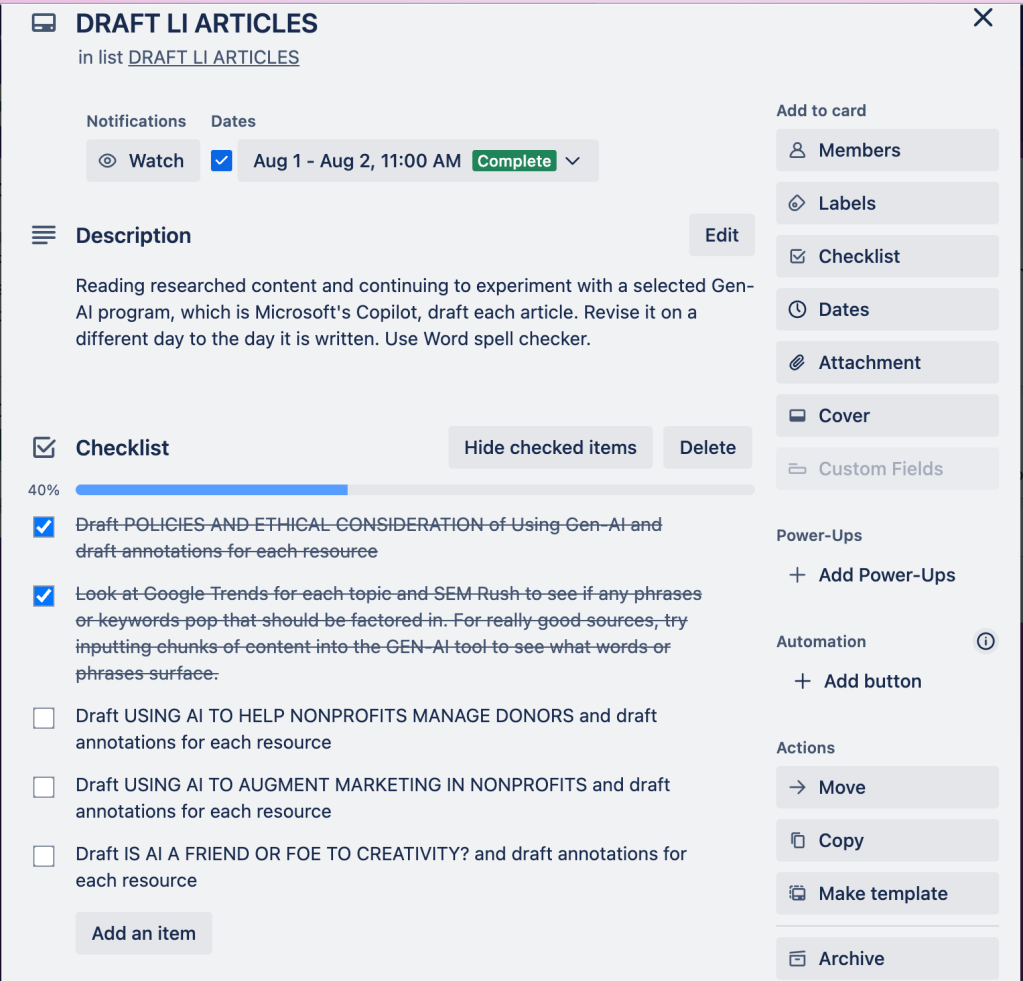
A draft of my first AI article will be submitted along with a Production Journal, which is essentially a timesheet of hours spent this week on different project tasks.
Not surprisingly, there isn’t much information on nonprofits use of AI, so my assumption is a full AI integration is more common in large organizations. There is real untapped potential if there is an appetite and resources to consider the gains and consequences in using AI to accelerate productivity and creativity.
-
Enhancing Productivity with Generative AI

The expansion of artificial intelligence (AI) is accelerating the pace and promise of technology to create a level of unprecedented productivity in several sectors, including nonprofits.
Concepts like crowdfunding have been around for years and enable nonprofits to tap the generosity of donors. According to Statistica, $17.2 billion in crowdfunding occurred just within North America in 2021and is expected to show an annual growth rate of 1.43 percent through 2028.
AI can make content used in fundraising campaigns more compelling by quickly providing information and ideas to engage audiences through photos, videos or text. Gen AI can help a creator to quickly assimilate an understanding of a particular audience or market and develop or refine creative ideas to engage audiences.
In the marketing and communications world, AI can draft a communications plan, provide initial ideas to spark a new campaign and draft letters and content for review. The quality of the information fed back is largely dependent on the way the prompts are written. I signed up for the Copilot Pro and found a version offered specifically for nonprofits looking for a productivity assistant to free up its employees to focus on the organization’s Mission.
Keeping a human in-the-loop to review information for accuracy is an important part of responsible AI use. According to the PMI, it considers AI as a “C” for consult or “I” input, so humans make the final decision. Phew, that’s a relief!
Using generative AI for creative endeavors raises a lot of ethical questions, some of which I will be discussing in next week’s blog.
Working Lunch of the Future
This week I tried the text-to-image technology called DALL-E and in a few seconds flat I got several image options in response to this prompt: AI doing human thinking while a project manager has a client meeting at a table of four people, mixed races talking over lunch.

Generative AI Overview for Project Managers
I just completed a short course by the Project Management Institute (PMI) that outlined how AI can help those charged with running projects of any kind to quickly learn enough subject-matter knowledge to lead a project. As this quote captures, the changes are going to be vast and not just at IBM:
“77% of IBM’s entry-level workers will see their jobs shift by 2025. Over the next few years, the use of generative AI will dominate all roles and all levels across an organization.”
Project Management Institute, Introduction to AI CourseOne project manager spoke of AI tackling more of the “behind-the-desk” repetitive assignments including meeting prep and recaps, report writing and analyzing data sets. In doing this, it frees people up for more face-to-face interactions.
Regardless of the chosen AI tool, keeping a “human in the loop” approach to using AI means quality is still a factor as is how this technological powerhouse will change peoples’ roles and their overall psyche.
A good place to start is for nonprofits to explore the AI options and have one or two people who are technologically inclined to test them to start an organization on its path to enhanced productivity.
-
Exploring How AI Can Inspire Acts of Generosity
The idea that creativity can be augmented and not replaced is fascinating to me. From all the buzz around the use of ChatGPT and similar technologies, the promise of AI to jump-start or refine the creative process was one I wanted to explore.
To make this true-to-reality, I tailored the proposal to a well-established nonprofit. It is an organization I’ve volunteered for in the past, so I’m somewhat familiar with its programs.
As we all stand in the new AI era, the ground underneath is moldable and discoveries are ours for the taking. I am looking forward to diving more deeply into the world of AI and seeing how technology can be an ally to nonprofits, often charged with doing more with less, in the name of their cause.
RFP Response
Hi nonprofit leader,
Thanks for inviting Greater Good Growth to respond to your RFP for marketing and communications services to help deepen engagement with your audiences including employees, volunteers and donors.
I understand from your RFP that you have decided to begin using Microsoft’s Copilot applications for nonprofits, to help optimize your operations and minimize costs. We know from working with other nonprofits, just how beneficial from a cost and time-savings perspective they find the new AI tools.
We have responded to each component of your RFP, and each week look forward to sharing with you the ways we are using AI to research information and boost creativity.
Knowing how overwhelming the sheer volume of materials flooding everyone’s email, mailbox and social media feed can be, we look forward to partnering with you on what will no doubt be a mutually beneficially initiative.
Based upon your supplier selection date of Friday, August 9, 2024 and a $15,000 budget, with the need to complete this work by the end of October 2024, outlined in our RFP response is a summary of what you can expect from us each week of the six-week contract. As requested, our proposal is provided via PDF and uploaded below.
Included in the proposal is a page showing our team. I expect for the work at hand, Olivia, Juliana, Drew and Donna will be working on this, and happy to answer any questions.
On behalf of everyone at Greater Good Growth Marketing & Communications, we’re thrilled to be considered for this new business that uses AI with the aim to inspire more generosity for your mission.
Warm wishes,
Julia Casey
-
Wheeler Gets Ahead of Behavioral Health

After an initial scan into @wheelerhealth history, I discovered an organization dedicated to increasing access to care for Connecticut residents who have mental health and/or substance use needs, to name just two.
Nonprofits like Wheeler that receive federal and state funding may not necessarily want to create outsized consumer demand, like a for-profit organization. That said, social media can create awareness and familiarity for Wheeler’s services by growing its followers and deepening online engagement, beginning with a branded campaign that positions Wheeler in the specific Connecticut markets it serves.
The social media audit uncovered a high volume of activity that communicates a compassionate and supportive organization providing an array of health care services. I recommend weighting content to the services in highest demand through short-form video, formatted for mobile viewing.
Sabrina Trocchi, PhD, MPA is an obvious voice to tap in social media to provide a level of gravitas to the business and health care communities, primarily through LinkedIn.
A Social Media Manager should handle the lion’s share of the work, working closely with the head of Wheeler on her content. This position could be further strengthened with a video producer to flush out the branded campaign. (If no budget exists for video production work, an alternative is to use the best available video footage, plus sound effects and text overlay to communicate the problem/solution.) Additionally, since many of Wheeler’s patients may speak Spanish, a bi-lingual Social Media manager is ideal.
Bigger picture, the financial burden of unresolved behavioral health issues on hospitals and the overall health care system persists.
The recommendation I put together is a positive step forward for Wheeler, its patients, staff and the communities it serves. Over time and with refinement, a social media plan can help people seek the services they need before a condition worsens, which in the long-run will lower costs and improve the bottom line.
-
A Closer Look at Links

Before we discuss the merits of embedding links within social media, it is helpful to consider the aim of posting in the first place: to build an ever-increasing community of engaged followers.
Engagement. That is like inviting your friends over for dinner to eat, drink and talk. No strings attached. The alternative is to invite friends over and then sell them some stuff – jewelry, booze, kitchenware. It seems that social media has moved away from its original intent and there is an increasing amount of commerce as people and organizations use social media for direct marketing.
During this course, I’ve learned it is better to have fewer followers and more engagement than vice-versa. So, will adding links to your social media help or hurt in that endeavor? Let us start by acknowledging how essential working links are when you want to get to information. There is nothing more frustrating than clicking a link that doesn’t work. Arghhh!
The podcast we listened to this week was the Science of Social Media by Buffer, why you shouldn’t add links to your social posts.
In his experiment, Buffer looked at 174,525,132 tweets published between July 15, 2022 – August 16, 2022, comparing two styles: posts that included a link and posts that didn’t include a link, but instead included a link in the bio. He indicates both samples are statistically significant sample sizes and that the post without the link performed so much better:
- Reaching 40% more users on average than tweets with a link
- Generating 9% more retweets
- Generating 21.24% more impressions/views
His net takeaway was then-Twitter favors tweets that use a link in bio instead of a link in the post. (That’s not necessarily the same thing as an experiment that compares posts with a link vs without, where the “constant” is they both have links in their bios.)
In terms of links in social media, especially Twitter, my takeaway is to use them sparingly and consider alternatives to connecting to those with shared interests, including hashtags. The Buffer podcast helped me to think about links more deeply, but it didn’t prove anything.
As I said in the beginning, the podcast felt like a sales pitch from Buffer, and I would have been more engaged if it were accurate or if it spent time talking about the value of using Buffer to build landing pages to coordinate with the release of social media.
-
Social Media: Lessons from Influential Figures

Looking through social media is a bit like reading a Dr. Seuss book. You never know what is coming next. Will you see a mouse, or a house, or green eggs and ham? Or a politician getting on a plane to attend a Peace mission for Ukraine.
So, knowing how influential a politician’s or business owner’s social media’s footprint is, I went on an excursion to check out a few LinkedIn, Facebook and Twitter accounts. With this week’s reading in mind on the benefits of authentic communication from likeable Social Media by Dave Kerpen, I came up with a few real finds to share below.
@CoryBooker, U.S. Senator for New Jersey has a wildly popular social media presence. He is transparent in his introduction as he says right up front that “most tweets (and typos) are mine, some are my team’s.”
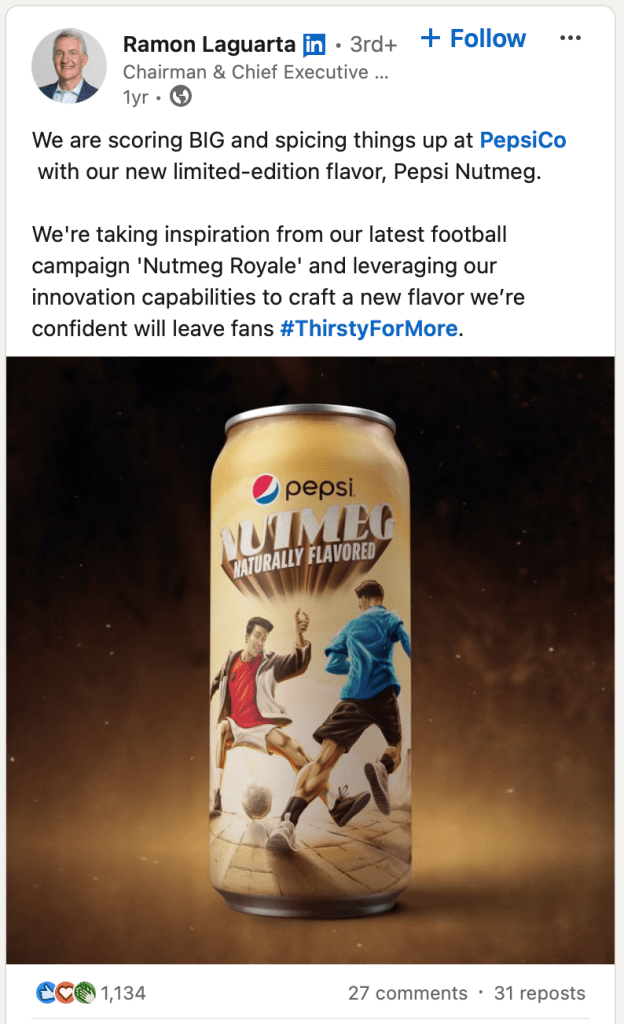
In the business world, I took a look at PepsiCo’s CEO Ramon Laguarta’s LinkedIn posts to find among the quarterly earnings updates, posts about FIFA Women’s World Cup and this one introducing a new limited-edition, Pepsi Nutmeg. The tone of all these posts is neutral, so seems like someone is posting on his behalf and just below this post are some disparaging comments about the working conditions in one of Pepsico’s warehouses, that according to the person who posted, need cleaning up. (I didn’t find any comments to address these remarks.)
If you have ever watched Jeopardy, you will recognize the face of Alex Trebek, longtime host who died in 2021. In his brief announcement posted to Facebook in 2019, he shares devastating news about his stage four pancreatic cancer because he didn’t want his fans to hear inaccurate information. He’s transparent, human and to his credit, manages to crack a joke about needing to fulfill his contract through 2022. This to me is just about the closest thing to being authentic and transparent in social media:
“This week I was diagnosed with stage four pancreatic cancer.” I am interested in social causes, so I looked at the social media presence for the head of Wheeler (Sabrina Trocchi, PhD, MPA) and found nothing on Twitter and only a light touch on LinkedIn.
All of this does make you think about the challenges in developing authentic posts while running a business.
Before I finish, I want to share a couple of endearing posts from Jacques Lamarre, playwright and creative professional for a Hartford-based marketing firm:
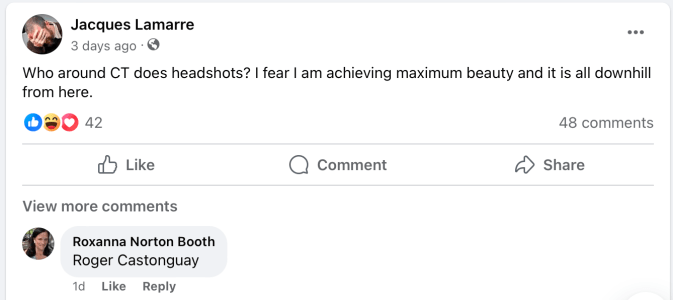
His sense of humor makes his posts easy to swallow and are some of the most entertaining I’ve found.
-
Economy of YouTubers Kicks into High Gear

While watching @mrbeast, one of YouTube’s top creators introduce his latest Wilderness Challenge, it is easy to get locked in. There are all the elements of a good story with a brief intro., rising tension, peak, fall and then wrap. The essence of the competition is people sleep in the great outdoors for a princely sum of $10,000 a day, which is parachuted daily to those who survive.
This twenty-six minute video is significantly longer than the average twelve-minute video, garnering over 40 million views, 3 thousand likes and 180,000 comments in just the first day.
@mrbeast is just one of many who makes up the “creator economy” YouTube Chief Executive Officer Neal Mohan referred to in his Feb. 6, 2024 blog. Here he makes four predictions for the future of YouTube including AI’s ability to expand creative boundaries, not inhibit them.
“YouTube has paid over $70 billion to creators, artists, and media companies in three years.”
Toby Hendy is another popular creator with 1.22M subscribers. Toby liked science documentaries in school so started to make her own. At the age of 15, she uploaded her first science video to @tibees. Two hundred and eighty-nine videos and 1.22M subscribers later, her content authority led to an opportunity for her to gather the perspective of politicians and business leaders on today’s school exams in their country. Her video scored 4.6K likes and more than 200 comments about exam ptsd:
People with stressful jobs react to world’s most stressful exams
YouTube has become the most widely used social media channel according to Pew Research’s Jan. 2024 fact sheet and second-largest search engine, following Google. People are now spending an average of 48.7 minutes daily watching YouTube videos in 2024, which is trending upwards according to Sproutsocial. And most people using YouTube are on a mobile device.
In a world that offers a plethora of news, entertainment and education options, it is clear that video content can capture and hold the viewers’ attention like no other channel, with engaging stories, documentaries and video shorts.
In an election year, using YouTube as an outlet for reliable news is an opportunity, especially with young adults.
About a quarter of U.S. adults get news from YouTube
Per Pew Research survey, Jan. 6 – 20, 2020
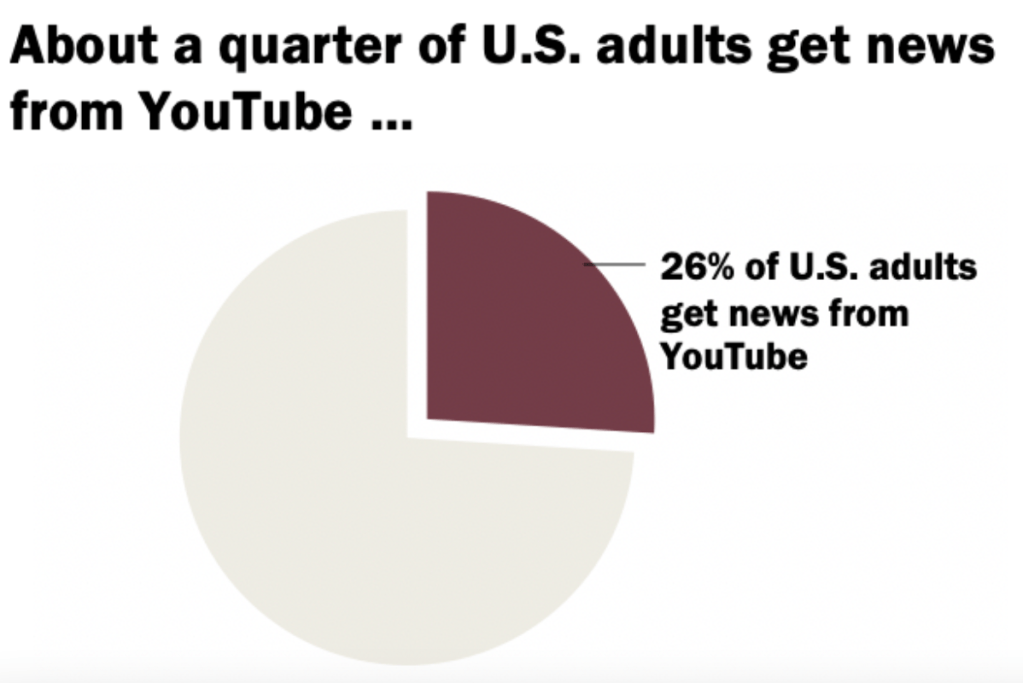
Most of these people say it is one way they get their news, but not the only way. Many reputable news outlets use video stories to augment their written content.
My guess is a year from now this number will be up to at least 30 percent.
While there are still times when the written word is a better choice than video, such as a long research paper or an in-depth news story heavy on statistics, there is nothing like video for demonstrating or explaining versus telling and selling.


Leave a Reply