-
The Promise and Potential of Digital Media


As she tucked a section of her jet-black hair behind her ear, Kiran’s eyes stayed locked on the open box of wearable smart glasses. She was rummaging with increasing fervor for the hot pink chipped pair that promised to satisfy both her curiosity and flair for fashion. Kiran lives in Hiware Bazar, a rural village in Maharashtra, India.
While listening to a podcast by Mark Zuckerberg about wearable technology and a future that will use glasses like smart phones, I was engrossed. Just imagine the possibilities for developing countries that could receive shipments of used tech portables in the same way they have reused computers for knowledge. Only this developing portable technology promises to respond to voice prompts and hand signals.
At the fast pace technology is moving, it may not be too long before smart phones become akin to televisions with antennas and the old school methods of communication where information was controlled by a select few.
Social media’s intent is engagement and interactivity through user-generated content, a complete 180 from where we have come. While watching someone’s user-generated cat video in our social media feed might be entertaining, did we always intend to see hard core news in such close proximity to frivolous content?
According to a 2023 Pew Research Center study that looked at how U.S. adults consume news, Search has become the second most popular access point for finding news and regardless of source, consumers are using digital devices to access news from multiple channels.
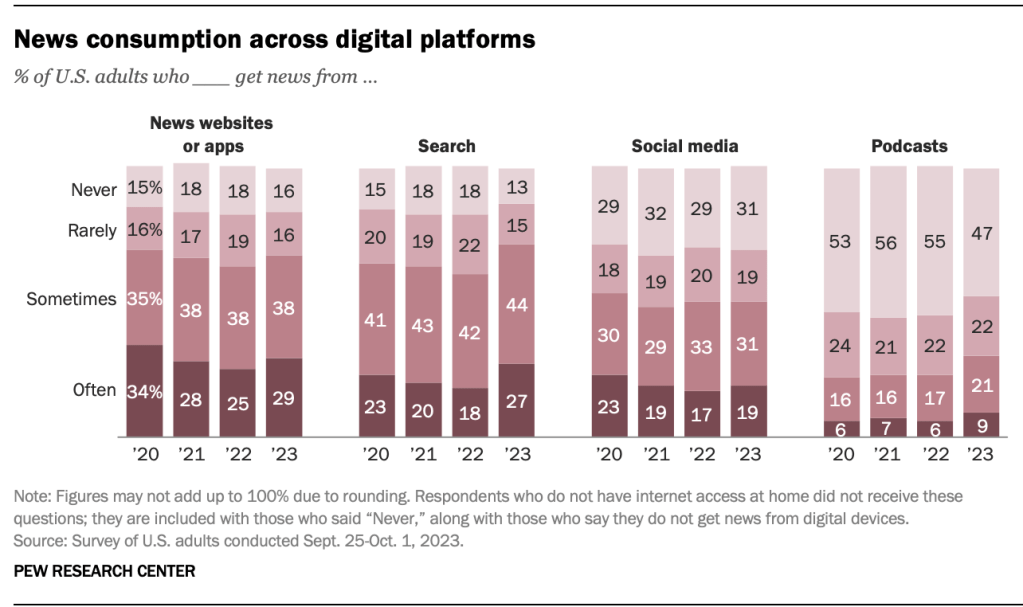
The following headline appeared in another 2023 Pew Research Center study examining Social Media consumption by U.S. adults:
“YouTube and Facebook are by far the most used online platforms among U.S. adults; TikTok’s user base has grown since 2021.”
2023 Pew Research Center studyWhat is also noteworthy is our appetite for video has far surpassed the written word as attention spans diminished.
In an election year where U.S. politicians rely on social media to carry the water for their campaign messages, the stakes are high as credible sources must rise up from the proliferation of fake news. Understanding social media usage by demographic, especially segments that are growing in size and power, like the Hispanic population will allow for focused messaging that enables politicians to appeal to the different needs of the U.S. population.
Meanwhile in Hiware Bazar, India, Kiran finds her fashionable pink smart glasses and checks her appearance in the dirty glass door before she bolts outside to explore her world-sized classroom.
-
A Data Privacy Business Expands Its Online Presence

The final assignment in Social Media Analytics (ICM 524): You are an online marketer. You mainly rely on email marketing and social media. A new prospect reaches out to hire you for her online consulting business. She uses her name for her branding. However, she is very much concerned about privacy issues in social media. She is overwhelmed with the idea of using her pictures or videos. Write an email to convince her that it is essential to effectively use social media as a marketing channel especially if someone has an online business. Suggest best practices for using social media safely.
If this is an online consulting business, I am going to assume that the prospect is a technologist who advises small business owners on how to protect their business hardware and client information against unwanted cyber-attacks. Let us say the business is called Heidi Sanders Data Shield, LLC. Heidi has been in business since 2020 and wants to acquire ten new clients in 2024. She currently has a business page profile on LinkedIn and she occasionally posts to Facebook.
Dear Heidi,
It was a pleasure to speak with you this morning. I was so impressed to learn about your online data protection consulting practice, your customer retention and strength in protecting their business data.
During our conversation you shared some powerful customer testimonials, in addition to data scenarios that can be turned into convincing online content. Understanding that you are looking to grow without sacrificing the services you provide to existing customers, there are ways to safely expand awareness and consideration, through social media.
- Building from where you are: you are already on LinkedIn that is a great place for sharing updates with your business contacts, in addition to joining Groups where you can converse within a focused professional community (e.g. information security and small business & independent consultant network.). There are a number of business products on LinkedIn to expand your company page and expand your followers through dynamic advertising.
- Twitter is another channel for reaching your audience by posting your views and resharing news stories, along with your opinion. We can @connect with influencers and journalists who cover data protection, and participate in the conversation so they will follow you.
- Information protection is at the center of your business so we will find and create relevant keywordsincluding a shortlist of hashtags that speak to what matters most to your small business clients. This will help in making your business more discoverable.
- Photography and video of select customer testimonials told through their stories or compelling infographics is one way we can engage small business owners.
- Geotargeting and other forms of audience targeting will allow us to selectively expand reach with small business prospects.
- Measuring social media impressions, engagement and click-through-rates will be a good starting point for us to tell which content is working best.
I know that many of your small business clients wouldn’t survive without strong data protection and many of the top threats of social media will be familiar to you in your line of work.
My aim is I’ve given you some food for thought in how we can work together to safely expand your online presence through social media. I am confident we can work together to communicate in line with each channel’s social media guidelines.
Look forward to discussing next steps.
Warm wishes,
Julia Casey
-
A Close Look at Facebook’s Privacy Standards

Beyond creative ways to communicate and measure social media, there is the vast topic of online privacy.
Facebook CEO Mark Zuckerberg is constantly in the news and has been called to testify on numerous occasions about his company’s data privacy practices. He is also known for his ingenuity. In 2021, he introduced the Meta brand as an umbrella for Facebook, Instagram and connected technologies.
Today, I am diving into what Facebook says about its privacy standards and the kind of information collected by this social media giant. In a nutshell, Facebook collects everything that a consumer views, creates and interacts with down to the individual user:
- Profile – name, email, phone number etc.
- Activity – includes all views, all user-produced content, messages, allowable metadata, with the exception of end-to-end encrypted messages.
- Off-Facebook Activity –information gathering extends to any activity including purchase behavior with Facebook’s advertisers, vendors and third parties, even if on another platform.
- Login – in addition to classic login mode there is a limited login option that doesn’t personalize or measure ad effectiveness. Obviously, not good for advertisers, but a choice for consumers.
- Device and software versions consumers use, including unique IP addresses assigned to consumer devices. Adding VPN can help to hide an IP address.
- Microphone – used only when a consumer gives permission and is using a feature that needs the microphone.
- Location-related information. Even if location services are switched off, Facebook can access a user’s IP address.
There are many options for users to manage their account and run security check-ups. The Privacy check-up is a good starting point. I notice that Facebook uses the language “control your information” in the same breath as it picks and chooses when anonymity is allowed. To me, there seems to be an imbalance over who ‘owns’ the data.
Facebook also uses the information to provide analytics to advertisers, communicate with users and for social good. It also reassuring to read an “innovate responsibly” claim in order to detect, prevent and combat “harmful or unlawful behavior” including preventing spam, online bullying and bad user experiences.
On the positive side, the benefit of all this information sharing is a personalized user experience, including ads, offers and tailored content that is growing in sophistication as the metaverse expands.
-
Google Mapping Boston Destinations
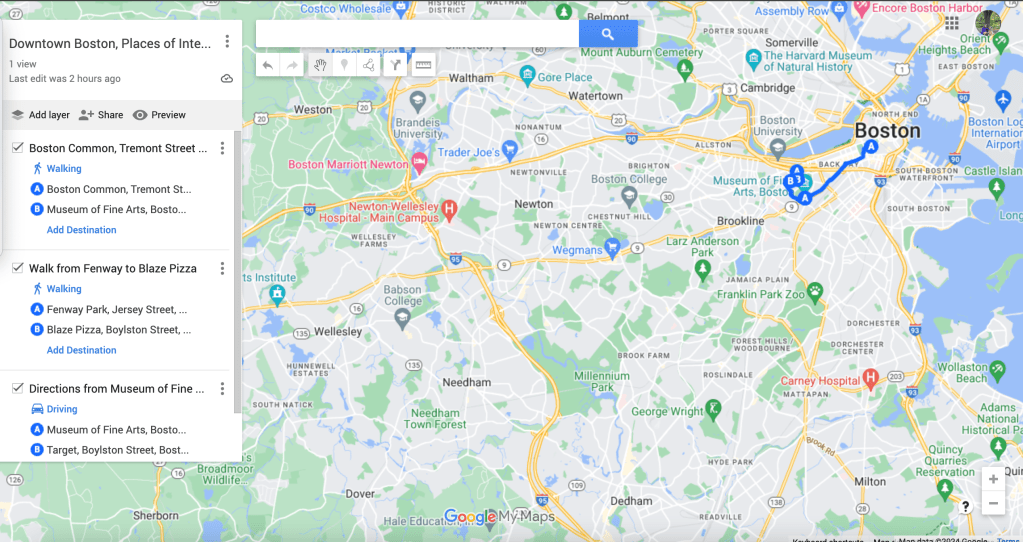
Basic radius targeting uses GPS locations to reach people, businesses and places based on location. Google enables users to create customized maps of destinations.
Spring break will soon be here, which is a good time to visit Boston. Here is a customized map of a day spent visiting a few popular spots, including Boston Commons, the Fine Arts Museum, Fenway and a local pizzeria.
To create this I searched places of interest and used the line tool to link from one location to the next, using the driving and walking options in the left hand toolbar:
-
Evaluating Boston Celtics Hyperlinks
March Madness is right around the corner so many people are tuning into their favorite team and thinking about their bracket selections. So today we are going to be taking a look at the Boston Celtics Facebook page.
Specifically, we will analyze one aspect of a site’s success: creating intentionally named and placed hyperlinks to increase site traffic and therefore search rankings. Paddy Moogan, co-founder of Aira, a UK digital marketing agency puts it like this:
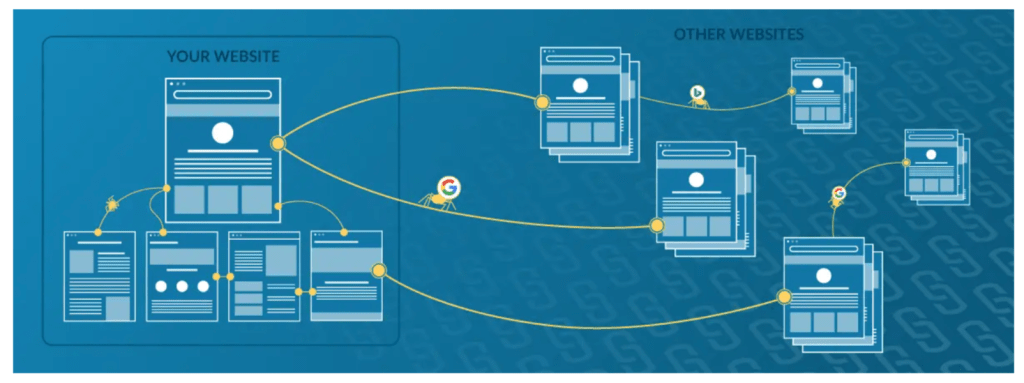
“A hyperlink (usually just called a link) is a way for users to navigate between pages on the Internet. Search engines use links to crawl the web. They will crawl the links between the individual pages on your website, and they will crawl the links between entire websites.”
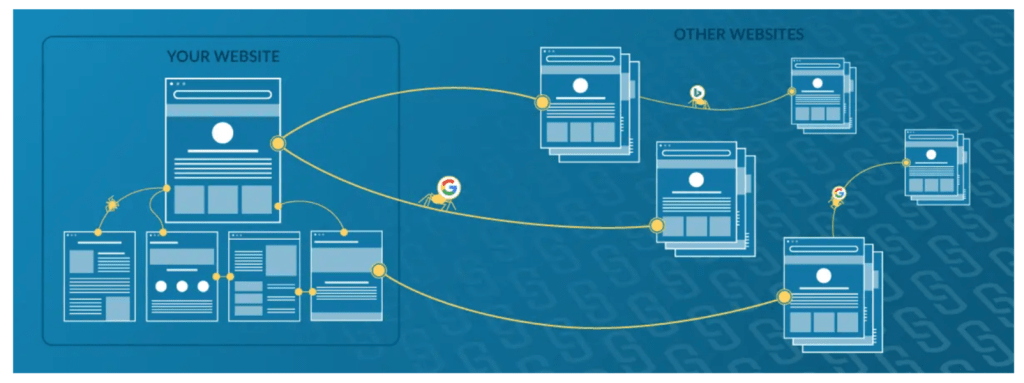
Why do links matter? Search engines don’t just look at the content of a page, they also analyze the number of quality links pointing to a social media page or website from external sources, and the quality of those hyperlink “referrals” that reside on other sites or in user commentary.
We are using Moz, a Search Engine Optimization (SEO) organization that has a number of tools to assist marketers in their quest to help organizations get in front of audiences.
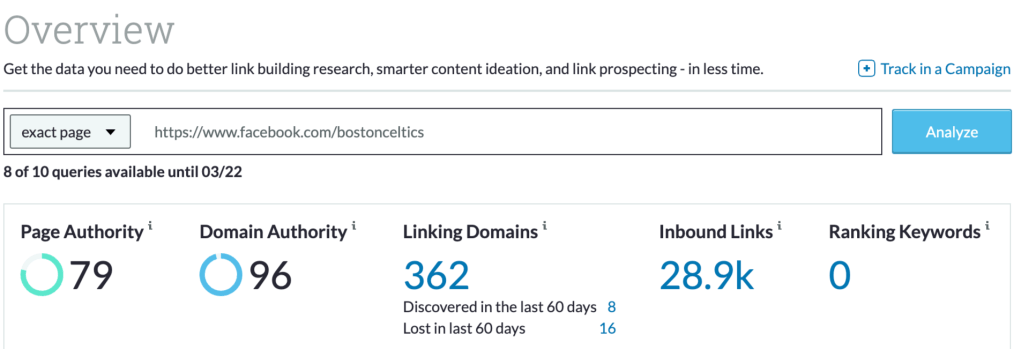
Using the specific URL for the Celtic’s Facebook page we can see this is a page with a great deal of authority (79/100) with 362 sites that link to the Celtics, boosting Facebook page traffic with close to 29k inbound links. I was surprised there weren’t any ranking keywords on the Celtics Facebook page:
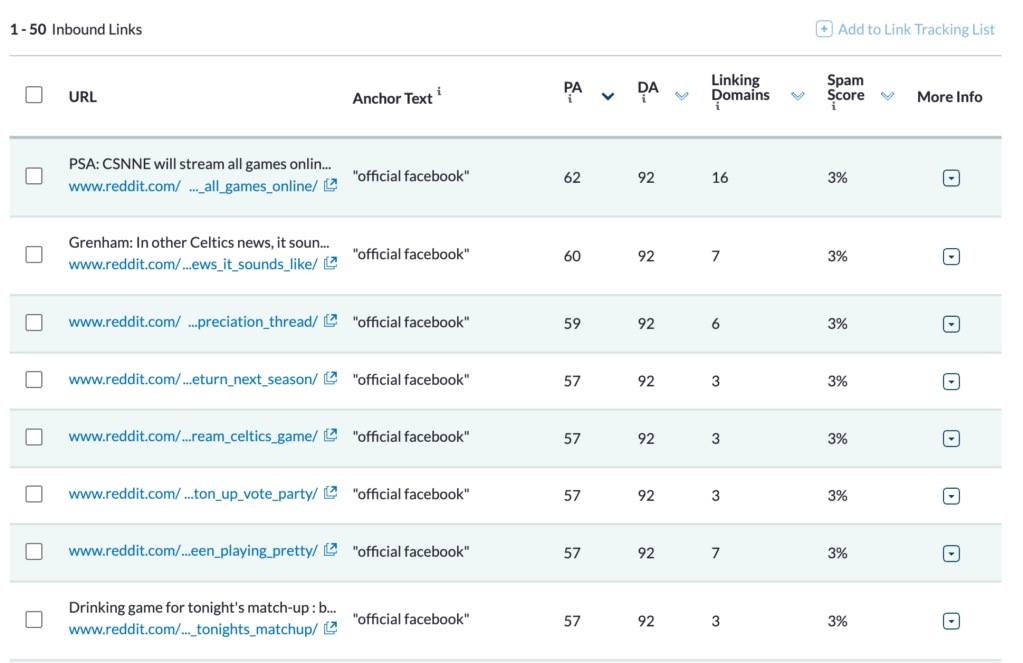
Looking through the first fifty in-links of the Boston Celtics Facebook page (sometimes referred to as back links or inbound links), almost every single one is coming from various links on Reddit.com, the social news and entertainment aggregator.
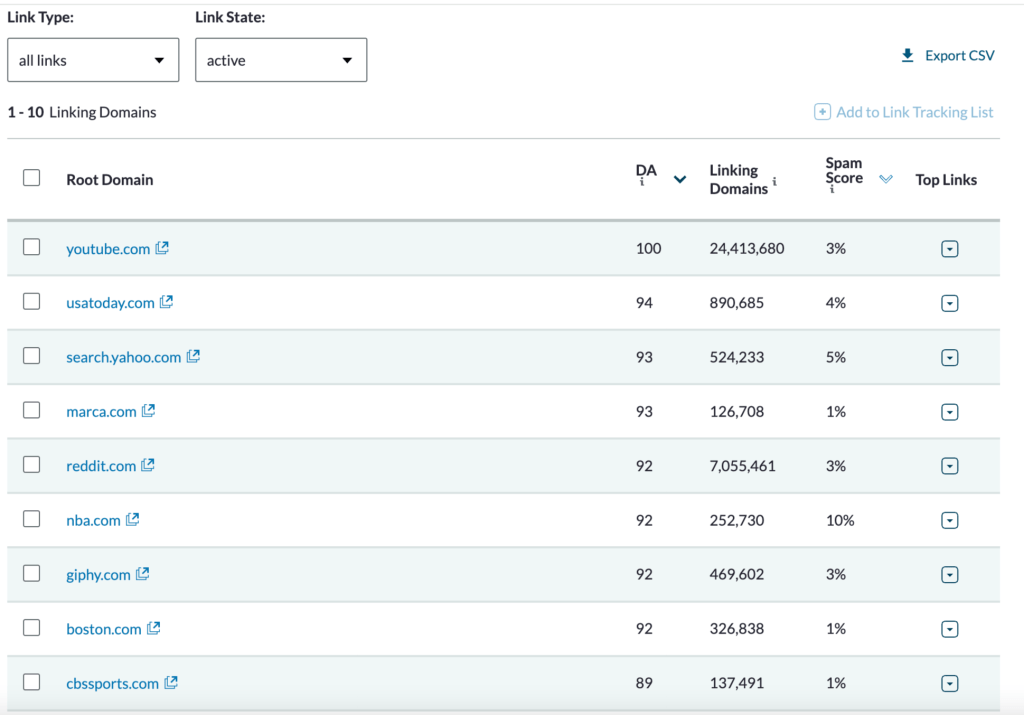
Looking at all links, we see other sites are connected with the Celtics Facebook page including YouTube, USAToday, Yahoo Search and Marca, a Spanish sports newspaper. Presumably these links are contained in their content posts or fans comments and can also help to boost the Celtic’s site popularity:
In the unstructured world of social media that most people live in, referred links typically come from online users who want to provide information or promote someone or something to their followers.
There are many implications for link analysis in other categories too, like book authors or speakers who want their writing or brand cited or co-cited by journalists, academics or other authors.
As for the Boston Celtics, they have already built a mega brand. In terms of expansion including influencers, I’d look to further understand how the Celtics audiences break down to identify growth potential, develop content that incorporates ranking keywords and hashtags, with expanded focus on its Spanish-speaking fan base.
-
Is the District of Columbia a Good Location for a New Drive-Through Coffee Chain?

This week in ICM 524: Your coffee manufacturing company is considering getting into the end-user market by opening ten drive-thru coffee shops somewhere in the country in the next 12 months and then another 25 by the following year. You, as the head of social media, will make research using Google Trends and prepare a report to the top management.
If you are like me and new to Google Trends, it looks back at how people search for information over different time periods. Each phrase is given a relative daily search term score, on a scale from 0 – 100. I couldn’t see how to run a search by State, so I am using the following to give a visual sense of which coffee types are popular across the U.S.:
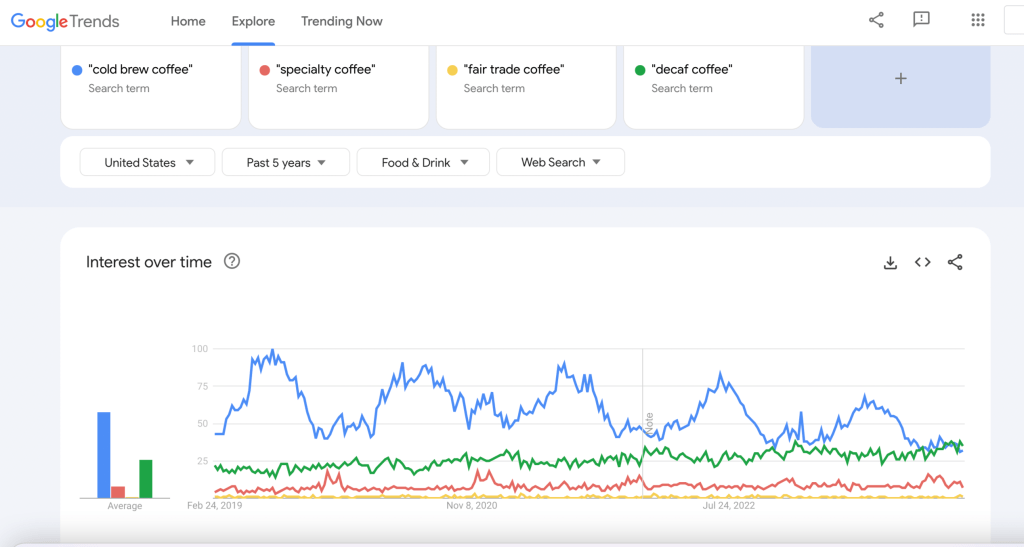
This kind of broad-brush search term can help in making product and some promotional decisions by showing product popularity and seasonal trends over the past five years, but it is limited because it is retroactive and there are many external present-day factors that would influence the potential success of a new drive through coffee shop chain: changing demographics, construction projects, ongoing return-to-work policies etc.
District of Columbia Neighborhoods
I found twenty+ neighborhoods in the District of Columbia, so more refined searches are needed to find the specific neighborhoods that offer an optimal mix of demographics and lifestyle to support a new drive-through coffee chain.
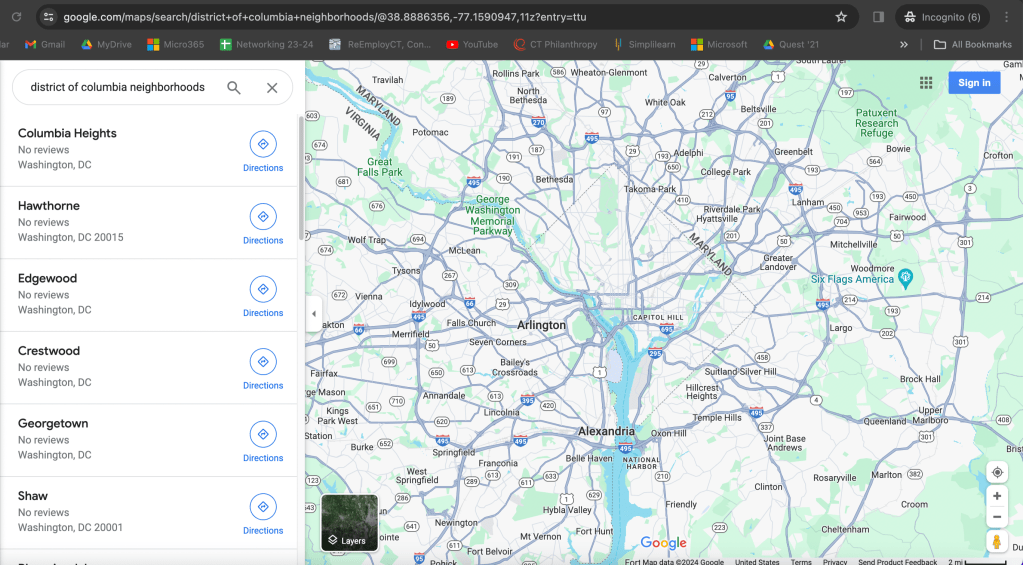
For another local overlay, let’s take a look at what the Yelp search term “best coffee near me” in the category of “coffee and tea”, “offers takeout” in the District of Columbia returns. I looked at the results for walking (2-mile radius) and driving (5-mile radius) to find other coffee shops in the area and what they serve. I didn’t find any options for drive-through in the District of Columbia on the Dunkin Donuts website. Starbucks seems to be more spread out throughout the State.
To build a national brand that competes with big names like Starbucks and Dunkin Donuts, a flagship location in a D.C. neighborhood could be one way to quickly establish a foothold.
Ref. District of Columbia
-
Mining the Right Words to Track as Hashtags

Marketers frequently incorporate keywords used by their target audiences to increase their chances of prospects finding their brand or products in search engines.
Since Twitter renamed itself to X in 2023, the microblogging platform has changed the way users pull and track analytics on its platform. While Twitter previously allowed users to access analytics for free via the Creator Studio, it is now only available on the native site with a paid subscription. Formerly, the primary analytics were impressions (number times posts appeared), profile visits, mentions and follower growth.
Subscribers now get a percentage of the revenue X earns from a users’ most engaged followers. So, Twitter users not only need more followers to have content appear more frequently, they are financially incented to have an engaged audience.
What is available on the platform is searching by topic or keywords. It also constantly updates with the top trending # conversations with options to search within News, Sports or Entertainment categories.
Credit to Alison K Consulting who developed an infographic to define the distinctions between using keywords for search engine optimization versus incorporating hashtags in social media. Social media hashtags tend to be shorter and are discoverable through search on the platform where the post appears. However, if relevant key phrases are incorporated into social media posts, then embedded keywords may appear in broader search page results. She captures the most important point here that holds true regardless of the platform or algorithm:
“The best way is to deeply understand the needs of your clients, and confirm the language they use.”
So how should we go about finding the most relevant keywords for social media hashtags and key phrases for optimization in search engine result pages?
Evaluating Hashtags for Social Media
In the arena of higher education where there are thousands of degree-granting institutions, incorporating specific hashtags into social media conversations is one way to get the attention of students and other key audiences.
There are Social Media Text Analytic tools to help organizations examine the patterns of user- generated comments and conversations taking place online. Tools include IBM Watson Natural Language Understanding, Google Cloud Natural Language API, Lexalytics Semantria, MonkeyLearn and Sprout Social.
Once a shortlist of keywords is generated, hashtags can be woven into social media.
Attempting to Use Sprout Social to Monitor Hashtags
I opened a Sprout Social account for the 30-day free trial that gave me the option to create a few preliminary keywords for the above higher education example. #grit, #21centurycareers, #createthefuture.
The Sprout tool wasn’t returning any data for a number of hashtags I tried, even ones that were trending on X like #SaturdayMorning. There used to be a free tool called TweetDeck to monitor specific hashtags in real time and view all related tweets as they were posted. What a great way for Social Media Managers to jump into relevant conversations!
Again, there is a newer version of this now available with a paid subscription in X. I’m also reading something called Flight School that aims and claims to provide free X (formerly Twitter) training.
Hey, I’m all about free and freedom! To be continued …
-
Serving More Meals to CT’s Hungry via Social Media
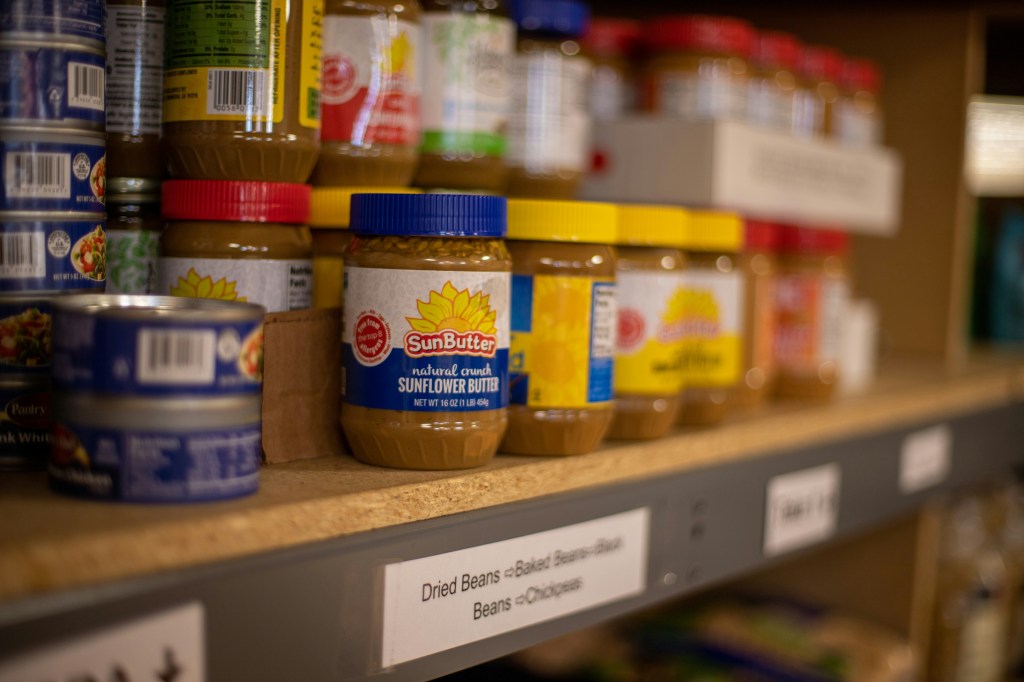
Connecticut Foodshare is an organization I have volunteered for and donated to in the past, so I decided to tackle this week’s assignment of “selecting the best metrics for the job” with them in mind.
Looking through Foodshare’s annual report ending 6/30/22, some of the biggest resource needs are food distribution ($71M in donated food) and food collection ($3M in expenses), which involves engaging its roster of 4,100+ volunteers. Besides staff, volunteers and customers, Foodshare partners with grocery stores that donate food as well as pantries/community kitchens.
Social media can and does play a valuable role for Foodshare via user-generated content from existing volunteers and donors. In reviewing existing social media, I found content in the following channels:
Facebook: 9,800 followers – reaches volunteers, employees and individual donors
LinkedIn: 2,000 followers – reaches businesses and organizations including corporate sponsors
Instagram: 4,346 followers – skews younger than FB, and promotes visual storytelling.
YouTube: 87 subscribers – didn’t find much content, see as an opportunity area to build content
A primary business goal is to increase the number of volunteers because it leads to deeper engagement, and eventually more donations. I did not see a tremendous use of hashtags so developing a few and monitoring their use could help Foodshare improve its social media impact if extracted, analyzed and used to make adjustments:
Follower Growth. With the above followers as a starting point and comments from volunteers and customers that need to be responded to in social media, Foodshare can jump into online conversations where needed. Looking in the audience insights tab in Facebook and Instagram shows where followers are located and their demographics.
Impressions. Measure the # times CT Foodshare content is viewed over time.
Engagement. Measuring a composite of likes/comments/shares over time.
Hashtags. There were 1.1M posts in Facebook alone using #foodshare, majority of posts were food-related community posts or cooking demonstrations. If Foodshare used a few more # consistently in content and user-generated content from its army of volunteers and partners, it would help to see what audiences are saying about topics it cares about.
Sentiment. On Foodshare’s Facebook page I found positive customer comments (with recommends) and another from a person who was upset about going to a food pantry and having someone cut in line ahead of him.
Click-Through-Rate. On social media posts and paid advertising, calculate CTR over time by taking the number of clicks and dividing by the number of impressions. Looking at this by type of creative will reveal what kind of content an audience enjoys the most.
Volunteer Sign Up. Of all the mini conversions that Connecticut residents can make to support Foodshare, signing up to volunteer is a central one.
Donations. Donating to Foodshare is a desirable action and being able to track the source of donations made through the website, including any social media sources.
Taking the time to extract, analyze and communicate key metrics to adapt strategy is well worth it. This includes keeping an eye out for the best time to post by reviewing the content tab in Facebook, Instagram and other channels to look for the days and times when posts get the most engagement so Foodshare can be out there when their audiences are likely to engage.
Social media has empowered consumers to take the reins of their own customer journey, engaging online in a way that puts them in the driver’s seat. Nonprofits like Foodshare who are visible throughout Connecticut can reap the rewards of a continuously improving social media strategy with metrics to back it up.
-
How #AlwaysLikeAGirl Performed in Social Media

Social media allows people to share information, exchange ideas and build community around common interests, causes or concerns. Social media content is fluid, interactive and user-generated so devising and tracking ways to measure content and associated networked activity can be less precise than tracking structured business data.
What you measure varies based on the business and the available metrics in each channel. Some standards include the number of followers, engagement (likes/comments/ shares) and social media text to analyze users’ sentiments and group key topics or feedback. These kinds of reactive metrics are descriptive analytics. They help organizations understand what is happening and how are they doing, and account for the vast majority of social media analytics.
#LikeAGirl
I like to communicate causes and found a campaign that goes back to 2015 publicized by Always, the brand that sells menstrual pads, a somewhat taboo topic. The Always website states its commitment to building girls’ and women’s confidence, so this video supports that aim with a post about gender identity.
Always brand tackles the topic of confidence by redefining what it means to be #likeagirl A look at key public metrics for this post: Facebook: 41k views, 232 likes, 20 comments – July 15, 2015 at 2:17 p.m. I could not find the shares for this particular post. On YouTube similar metrics show 102,970 views and 724 likes from May 3, 2018.
In comparison to benchmarks for social media found through a ChatGPT search for the consumer-packaged goods category where the average engagement rate is reported to be 0.16% to 0.5%, the Facebook post didn’t fair as well, whereas the YouTube Channel did. The following calculation is from a Hootsuite social media metrics blog, which uses the following formula to calculate an Average Engagement Percentage Rate on Facebook:
Likes/comments/shares divided by Total Followers x 100 (252 divided by 448k FB page followers x 100)= 0.056
Beyond these visible social media metrics, the company may track web traffic, product sales and brand attributes like “Confidence” and monitor comments made in social media containing empowering phrases. The specific comments found in the above Facebook post were all affirming and frequently included @mentions to spread the message organically.
According to the book, Creating Value with Social Media Analytics by Gohar F. Khan, one of the challenges in using social media analytics is how unstructured and disparate the metrics are across channels. This can make it challenging to report and use social media analytics to inform business decisions.
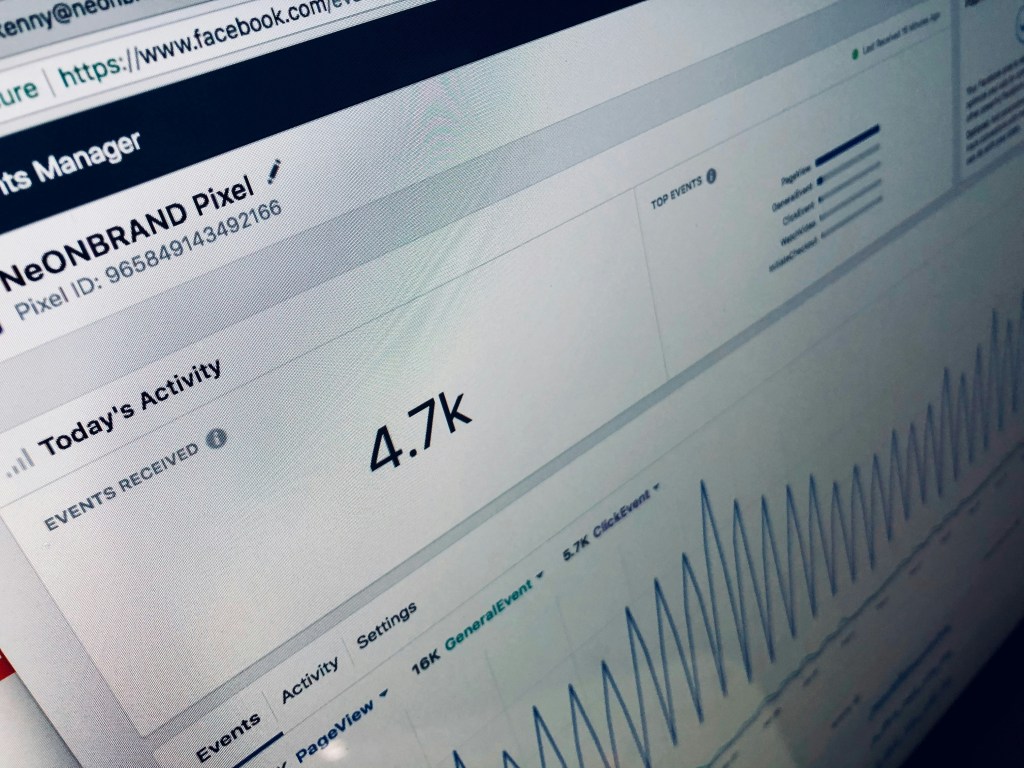
In the real world there are several analytics tools to help social media practitioners analyze how well an organization is reaching its audiences. Each channel has its own analytics and there are tools that tout aggregation across media, including SAS Visual Analytics and some of the publishing platforms like Sprout Social embed their own customizable analytics tools. I wonder how reliable these sites are compared to the more manual method of going into each site individually and extracting the necessary data. In this brief TikTok tutorials, we learn all the analytics available locally including followers, profile views, comments and video views. Once extracted, social media data may need to be cleaned, analyzed, visualized and interpreted to be able to present easy to interpret findings.
Always seems to be creating a brand that stands for something well beyond the products it sells. What social media metrics do you care about the most? Keep the conversation going at linkedin.com/in/juliacasey1
-
Why Improv Is For You

“Sound is an excellent connecting device across cuts.” Tom Schroeppel, the Bare Bones Camera Course for Film and Video.
With an L cut, as the visuals change from one shot to the next, the audio carries over visual cuts to provide continuity or a lingering effect. In the editing software it looks like an upside down T to me, as the audio transitions over one or more visual cuts.
With a J cut, the audio precedes a scene/shot cut, providing clues or intrigue about what the upcoming clip will show. I looked several movie clips to find one sample J cut in this clip of an execution gone wrong (see 1:53) where the preceding audio/video sets the stage for the execution.
These editing effects are used to:
Share the thoughts of a character
Closeout a film or establish the opening shot
Montage voiceover
Dialogue scenes
In Shaun of the Dead, I found a few sample L cuts:
Discussing the plan: here the audio conversation continues over a series of fast-moving video montages (L Cuts) as he shares his plan (example :05), the dialogue that shows facial expression (example :42), then closes the segment with another L cut that trails the audio from the news flash shot to their surprised expressions at the closing scene.
Oblivious to the Zombies: the sound effects create a tension that builds as he walks into the corner shop and opens the blood-stained refrigerator unit, the eerie background sound effects shifting at 1:06 (L Cut) to an ethnic-sounding off-key note that continues to build at 1:36 (L Cut) as he leaves the corner shop, communicating that something is off or is about to go wrong.
In Good Will Hunting, here’s a scene with examples of the L cut that incorporates dialogue carried over over multiple shot changes to capture the reactions of those in the bar listening to the situation unfolding before them. I chose it because it shows facial reactions to ongoing dialogue.
At :38 you hear Ben Affleck’s conversation begin while seeing the reaction of a fellow bar fly whose taking it in, as is Good Will Hunting that begins at 1:03 and again at 1:22 .
Self Reflection
This course has definitely helped me to be more of a visual thinker than I was before, which I’m sure will help in all of my future communication endeavors. While I’ve written many planning/creative brief documents, this course has armed me with some video production techniques using Premiere Pro, a software product I have never used before.
Create
After last week’s reading on the importance of lighting, I focused on creating a three-point lighting effect, using a halo ring light for the key light (in front of my subject), a floor lamp created light behind my interviewee, and a softer floor light created some additional fill light.
Taking a page out of the final words from the Tom Schroeppel book we used for this class, here are my own critiques of this video: I am noticing a yellow glow behind my interviewee, which is a little distracting and possibly could be cleaned up with additional editing. For the shot framing, you can see some junk on the floor in the next room, which didn’t look as prominent on the day of the shoot.
I followed the brief and created a conversation that followed the key points I included in the planning document. I created an introductory J cut at the beginning, opening with background laughter to set the tone and then added some L cuts later as Claire talks about her approach to improv and I show b-roll that I captured at the Hartford-based comedy club where she performs.
While I did find some background music, I didn’t add additional sound effects because I felt Claire’s narration was enough by itself.
Claire Zick has performed improv for more than twenty years and now teaches others the key tenets, including active listening and building upon the ideas of others. Listen to Claire’s perspective on this playful art form that can help so many people with critical career and life skills while having fun.
Thinking about giving improv a try? Take a few minutes to watch this and reach out to Claire for details. #Improv #Fun #Spontaneous
 On A Mission
Leave a comment